
Reaching, bending, turning: why does the body move as one piece?
Why does the body move as one piece when you reach or stand up? How muscles link through fascia, what the myofascial line evidence says, and how to train it.
You reach for the jar on the top shelf. Your heel lifts, your ribs open, your opposite hip turns slightly. You think you are only raising your arm; your whole body is in on it.
The body works as one piece because muscles do not work independently of each other. Part of the force a muscle produces passes to its neighbours through the surrounding connective tissue, and the nervous system builds movement as a whole, not muscle by muscle. To move comfortably in everyday life, training movements as a whole like this is at least as useful as training muscles one by one.
When one muscle contracts, does its neighbour get pulled too?
In the classic explanation, muscle pulls tendon and tendon pulls bone. In reality it is a bit messier. The connective tissue wrapping a muscle (fascia) runs on without a break into the sheaths of neighbouring muscles, and a measurable share of a contracting muscle's force travels through these sheaths to the muscles next to it, sometimes further.
The best example is at the back of the waist. In the broad sheet of fascia where the lower back meets the upper back, the large back muscle that connects your arm to your trunk meets, from one side, the big buttock muscle from the other. When you pull a heavy door with your right arm, there is a bridge along which part of the force can travel towards your left hip. The anatomy of the bridge is well documented; how much force actually crosses it, we do not know for sure. We covered how this bridge relates to pain in the article on the lower back and hips.
What does functional movement mean?
The nervous system does not manage muscles one at a time; it builds movement out of groups of muscles that switch on together (muscle synergies). Getting up from a chair is a single movement from start to finish: your feet press into the floor, your trunk leans forward, your hips lift, your knees straighten.
Functional movement means training these movement patterns you use in daily tasks: getting up, reaching, turning, carrying. Research backs this up: at the same load, movements that work more than one joint build at least as much strength as single-joint movements.
This does not mean isolated training is wrong. If you want to grow a muscle or put targeted load on a specific area, isolation works. It is just not the only route to moving comfortably in everyday life.
Are myofascial lines real?
Myofascial lines (anatomy trains) are a mapping model that links muscles and fascia into bands running from the sole of the foot to the head. In books they are all drawn with the same certainty, but the evidence is not that clear.
In a systematic review of cadaver studies, the back line and the back and front functional lines held up well, the spiral and lateral lines were partly confirmed, and the superficial front line, running from the top of the foot up the front of the body to the head, was not supported. The back functional line uses exactly the bridge described above. So some of the best-supported connections match movements where the trunk works crosswise.
Seeing in a cadaver that two tissues run on without a break does not, on its own, prove that meaningful force passes along that line in a living body. There are small studies showing that stretching the back of the legs increases neck movement, but these are still preliminary findings. The lines are a useful map for reading the body. They are not a treatment recipe.
Don't bones carry load?
Tensegrity is a model that describes the body as standing up not like a pile of bricks but like a tent: bones are the poles, muscles and fascia the ropes that spread the load across the whole. As an analogy it is helpful, and at the scale of the cell it is supported by experiments. That the whole body works exactly like this has not been proven, and the evidence supporting its use in manual therapy is found to be insufficient.
Some popular sources go a step further and say "bones don't carry load, fascia does". That is not true. Even in a tent, the poles carry load. Bone carries the body's weight; muscles and fascia share and spread that load, they do not replace bone.
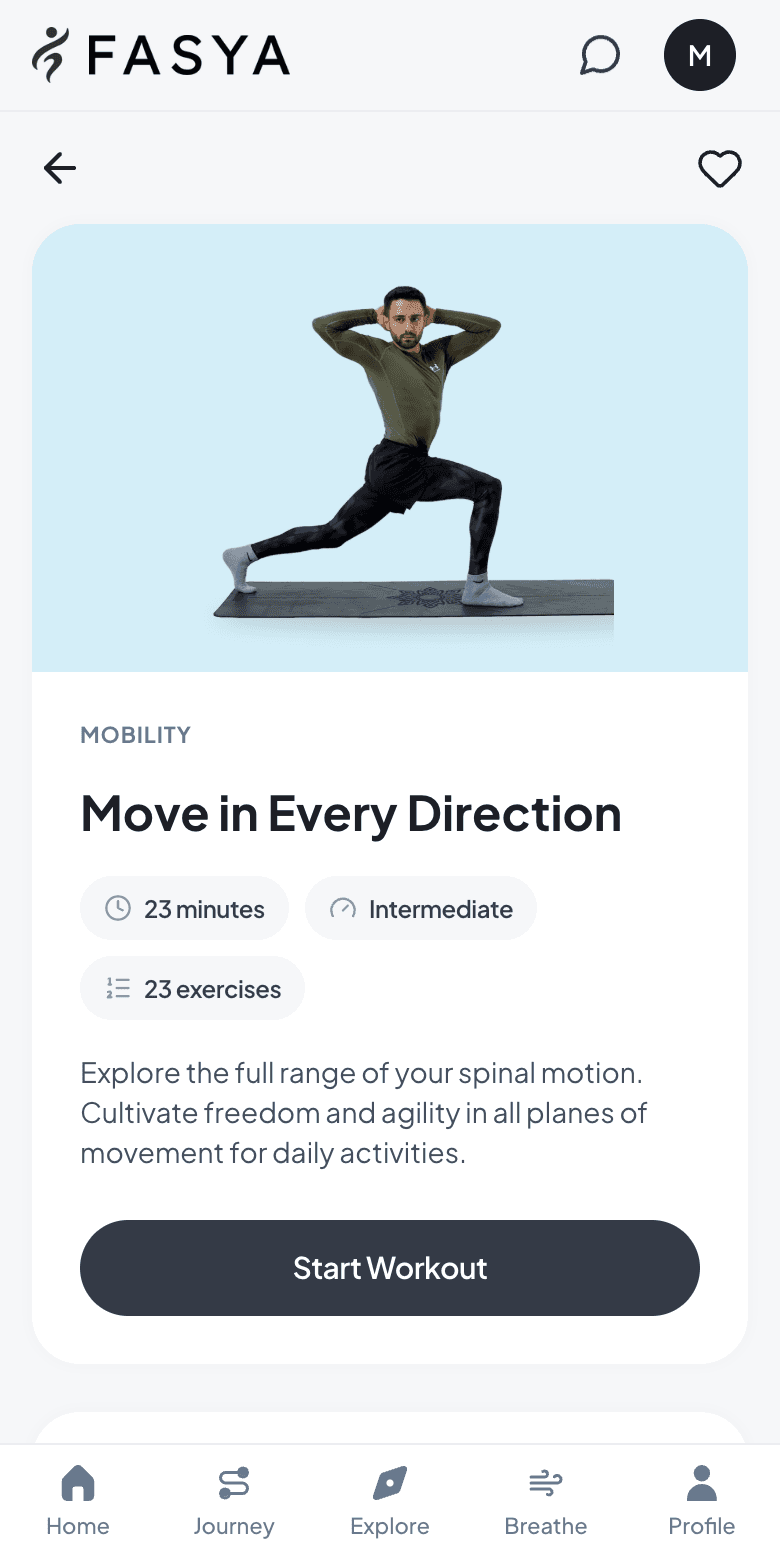
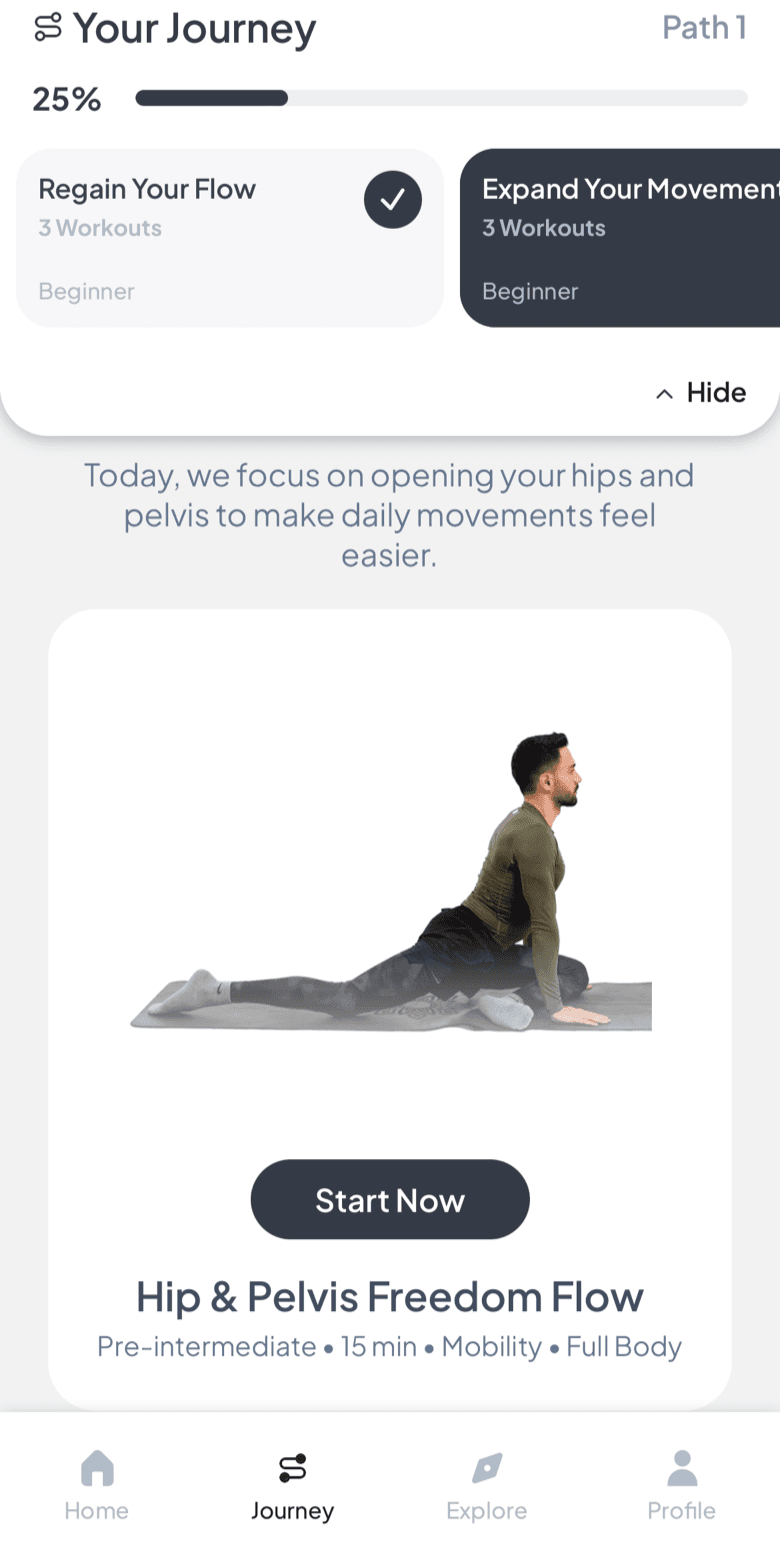
In practice the meaning is simple: instead of trying to fix a single area, work the neighbours that lean on it, one after another, in the same session. Fasya is a mobility app that builds you a route of workouts that follow on from each other, based on the area that feels restricted; the routes are put together with this idea in mind. Its Move in Every Direction workout also takes the spine through every plane.
How do you train everyday movements?
You do not need a gym for this; the day already gives you plenty of chances:
- Reaching: When you reach for a shelf, reach from the shoulder without bending the elbow. Notice your shoulder blade sliding and your ribs opening.
- Turning: Most trunk rotation comes not from the lower back but from the upper back, where the rib cage is. In MRI measurements the total rotation of the five lumbar vertebrae stays under ten degrees. When you look back in the car or turn sideways in your chair, try to turn from your rib cage, not your lower back.
- Getting up: When you get up from a chair, do it without pushing off with your hands, shifting your weight onto your feet.
- Reaching crosswise: On all fours, stretch out one arm and the opposite leg at the same time. It is a movement that uses the crosswise line in your back.
- Arm swing: When you walk, your right arm goes forward with your left leg. Let your arms swing freely and let your trunk rotate slightly.
How many reps should you do? There is no exact number. A few times a day, each with a few slow reps, is a good start. A little every day is easier to keep up.
In short
The body works not piece by piece but as a whole: a muscle's force passes to its neighbours, the lumbar fascia links the back on one side to the hip on the other, and the nervous system builds movement as a whole. Reaching for a shelf, turning round to look back in the car and getting up from a chair are the shortest ways to use that whole every day.
Frequently asked questions
- Why does the body move as one piece?
- Muscles are linked to each other by connective tissue, and part of a muscle's force passes to its neighbours. The nervous system also builds movement not with individual muscles but with groups of muscles that switch on together.
- What is functional movement?
- Training the movements you use in daily tasks: getting up, reaching, turning and carrying. At the same load, movements that work more than one joint build at least as much strength as single-joint ones.
- Do myofascial lines really exist?
- Some of them do. In a review of cadaver studies, the back line and the back and front functional lines held up well, the spiral and lateral lines were partly confirmed, and the superficial front line was not supported. The evidence for their remote effects is still weak.
- Is it possible to work just one muscle?
- Yes, and sometimes it helps: even though part of the force passes to the neighbours, isolation work strengthens the target muscle. For moving comfortably in daily life, though, multi-joint movements work at least as well.
Sources
Sources are taken from the expert-reviewed content cards in Fasya's knowledge base.
- Defining the fascial system — Adstrum S, Hedley G, Schleip R, Stecco C, Yucesoy CA, 2017
- Not merely a protective packing organ? A review of fascia and its force transmission capacity — Wilke J, Schleip R, Yucesoy CA, Banzer W, 2018
- What Is Evidence-Based About Myofascial Chains: A Systematic Review — Wilke J, Krause F, Vogt L, Banzer W, 2016
- Remote effects of lower limb stretching: preliminary evidence for myofascial connectivity? — Wilke J, Niederer D, Vogt L, Banzer W, 2016
- Anatomy Trains, 4th edition — Myers TW, 2020
- Cellular tensegrity: defining new rules of biological design that govern the cytoskeleton — Ingber DE, 1993
- Tensegrity I. Cell structure and hierarchical systems biology — Ingber DE, 2003
- Tensegrity and manual therapy practice: a qualitative study — Hohenschurz-Schmidt DJ, Esteves JE, Thomson OP, 2016
- The thoracolumbar fascia: anatomy, function and clinical considerations — Willard FH, Vleeming A, Schuenke MD, Danneels L, Schleip R, 2012
- Kinematics of the lumbar spine in trunk rotation: in vivo three-dimensional analysis using magnetic resonance imaging — Fujii R, Sakaura H, Mukai Y, et al., 2007
- An in vivo study of the primary and coupled rotations of the thoracic spine — Willems JM, Jull GA, Ng JK-F, 1996
- Neuromechanics of muscle synergies for posture and movement — Ting LH, McKay JL, 2007
- Resistance Training with Single vs. Multi-joint Exercises at Equal Total Load Volume — Paoli A, Gentil P, Moro T, Marcolin G, Bianco A, 2017
This article is for information only; it does not diagnose and is no substitute for an examination. If your symptoms persist, see a clinician.
Related articles
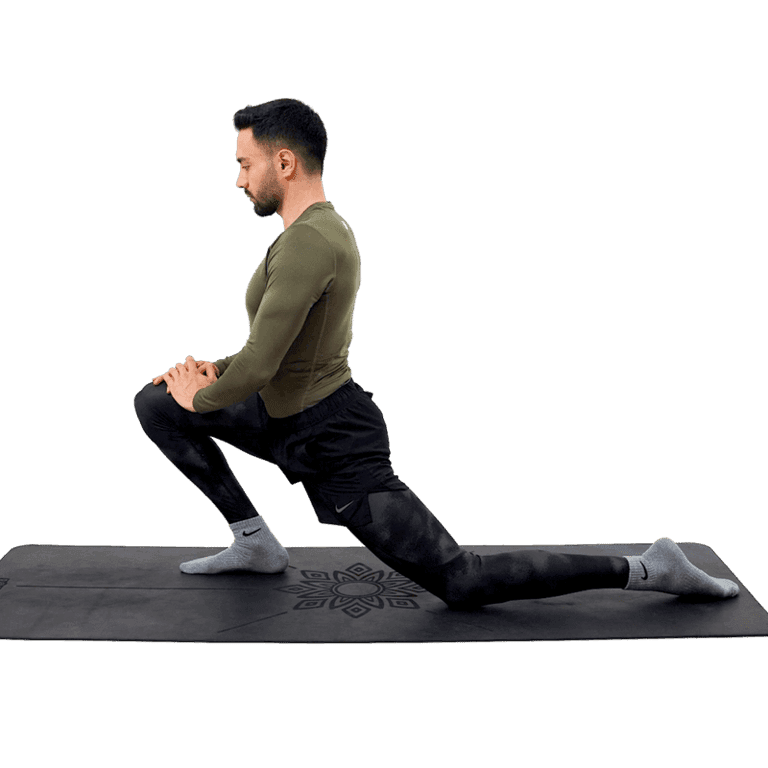
Your lower back hurts. Could the problem be your hips?
Plenty of videos tell you your lower back pain is "really a hip problem". The lower back and hips do meet in the same fascial layer, but the evidence for blaming the hips alone is weak. When does training the neighbouring region help, and where does the evidence stop?
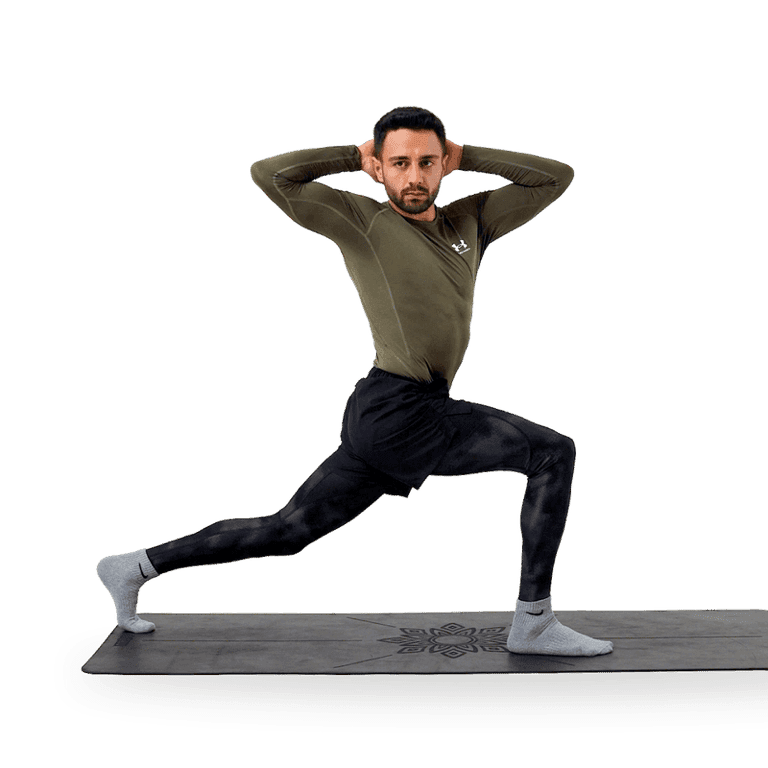
What is fascia? The web that makes the body one piece
Everyone talks about fascia, but few explain what it is. From the skin of an orange to nerve endings: what fascia really is, which claims rest on evidence, and why listening to your body is a skill you can learn.
How does slouching affect your body?
Hunch over a screen for hours and your breath seems to catch somewhere. How slouching affects your breathing, neck and lower back, where the evidence is clear and where it's blurry, and a simple way to open your ribcage.