
How does slouching affect your body?
How does slouching affect your body? Breathing, lungs, neck and lower back, where the evidence is clear and where it isn't, and how to open your chest.
Three in the afternoon. You're leaning toward the screen, shoulders rolled forward, chin creeping closer to the monitor. You want to take a deep breath, and it seems to catch somewhere.
The short answer: the clearest effect is on your breathing. When you sit hunched, the front of your ribcage closes and your breath gets shallow. Your upper back also rotates less, so the work falls to your neck and lower back. Whether it harms your lungs in the long run depends on age: in older adults a pronounced upper back curve has been linked to a faster decline in lung function, but no such harm has been shown for a young desk worker.
What happens to your breathing when you slouch?
Breathing doesn't happen only in the lungs; it happens through your ribcage opening and closing. Most of your twenty-four ribs attach to the spine at the back through two small joints, which means more than forty joints in your back move with every breath. When you breathe in, the diaphragm, your main breathing muscle, moves down and the ribs open out to the sides and forward.
When you lean forward and stay there for a long time, the front of your ribcage closes and the ribs have less room to open. Your breath gets shallow, and shallow breathing leaves the rib joints less movement. Part of that catching feeling comes from here. We explain how to tell whether you breathe into your chest or your belly in a separate post.
Does slouching damage your lungs?
Here the strength of the evidence depends on age. In a study that followed older adults for years, those with a pronounced upper back curve saw their lung function decline faster. That's an association, not proof of cause and effect, but it's worth noting.
For a young desk worker, saying "I can't breathe properly because I slouch" is reasonable but unproven. What we know more firmly is the immediate effect: a hunched position leaves less room for your breath, and when you change position that room comes back.
Does slouching affect your neck and lower back too?
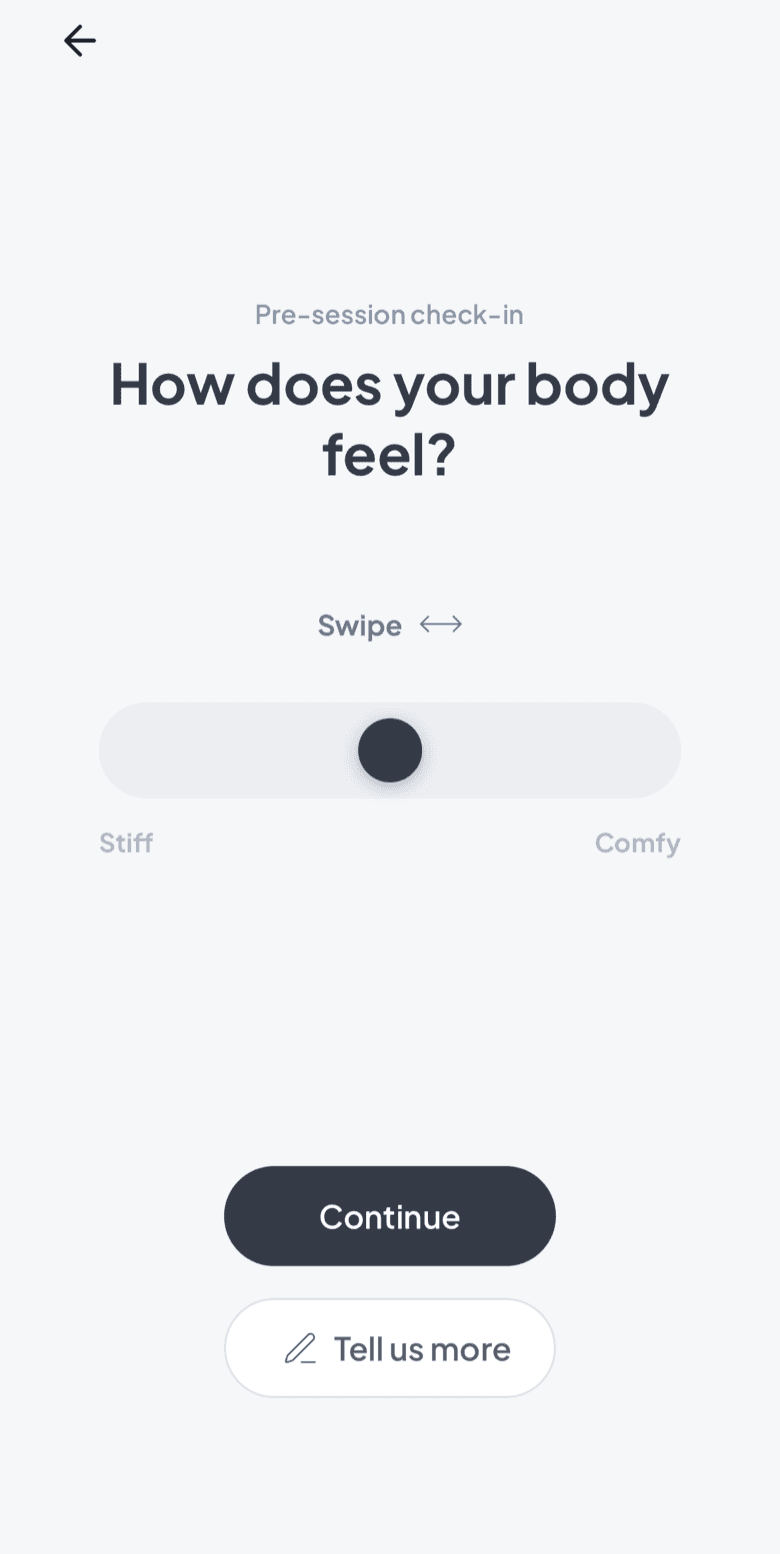
Most of your trunk rotation comes not from the lower back but from the upper back, where the ribcage is. In MRI measurements, the total rotation of the five lumbar vertebrae stays under ten degrees. Sitting hunched and still for hours keeps your upper back away from that movement. When the upper back doesn't rotate, the work falls to its neighbours: the neck turns more, the arm reaches further, the lower back strains. We don't know for sure how much of this turns into everyday pain; rotating your upper back now and then is still an effortless precaution.
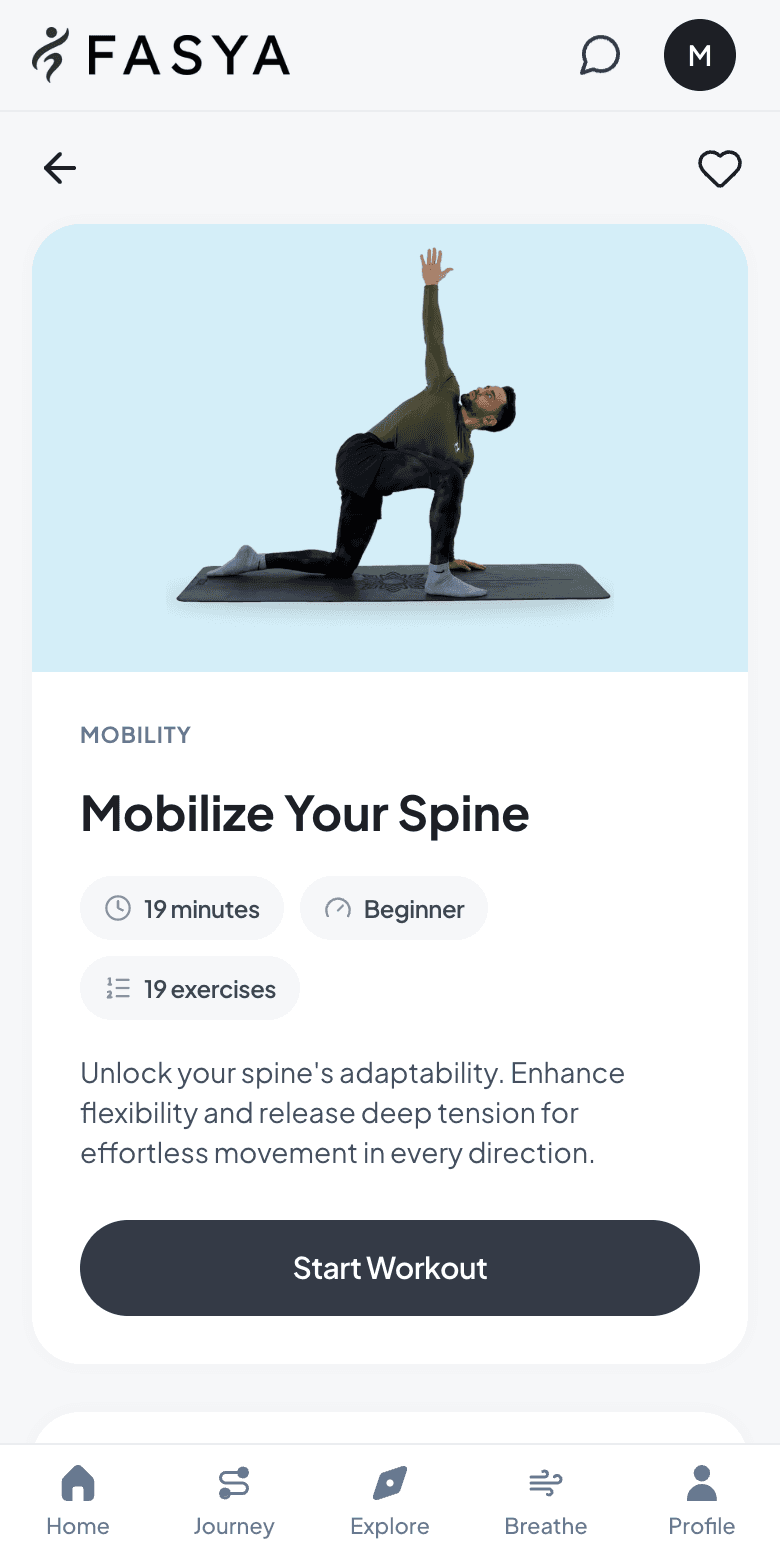
So the goal isn't to try to sit bolt upright for hours. Changing your position often and opening your ribcage now and then is easier to keep up. Fasya is an app made of short mobility and breathing sessions; before each session it asks how your body feels. The Mobilize Your Spine workout is another option for rotating your upper back.
How do you open your ribcage at your desk?
- Make room for your ribs. Place your hands on both sides of your lower ribs. Breathe in slowly through your nose; let your hands move out to the sides without your shoulders lifting. Five or six breaths are enough.
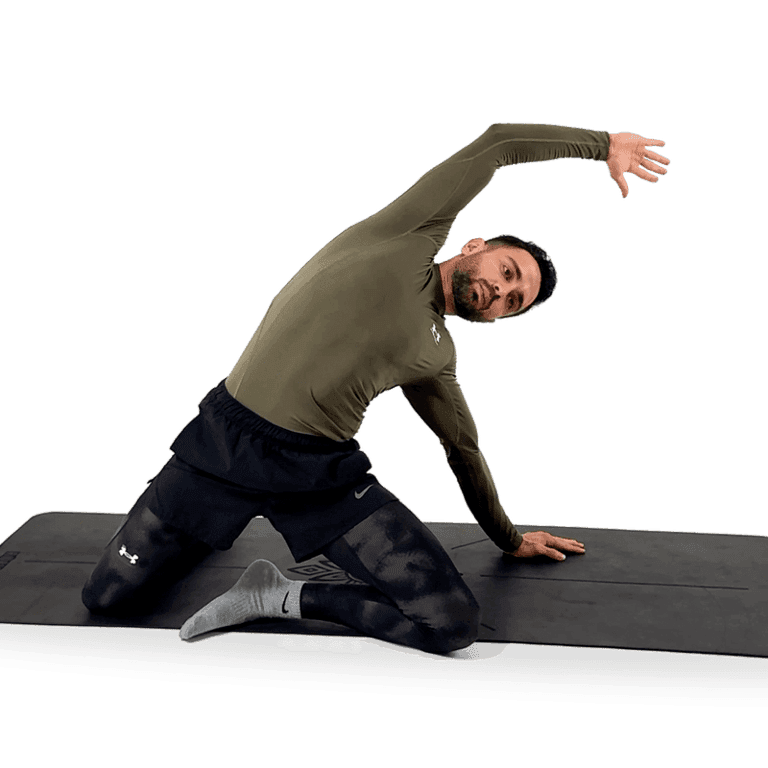
- Rotate your upper back. Most trunk rotation comes not from the lower back but from the upper back, where the ribcage is, and the ribs move as you rotate. Slowly turn right and left where you sit.
- Reach up. Stretch your arms up over your head and feel your ribs open.
- Change how you sit. Get up for a minute every hour, or at least change your position.
The goal isn't perfect posture; it's keeping your breath from being squeezed into the same tight space for an hour.
Frequently asked questions
- How does slouching affect your body?
- Its clearest effect is on breathing: the front of your ribcage closes and your breath gets shallow. Your upper back also rotates less, so the work falls to your neck and lower back. Long-term harm depends on age; no lasting damage has been shown in young people.
- Does slouching affect your breathing?
- In the moment, yes. Sitting hunched closes the front of your ribcage, reduces how much your ribs open and makes your breath shallow. When you change position, that room comes back.
- Can slouching damage your lungs?
- In older adults, a pronounced upper back curve has been linked to a faster decline in lung function. In young people, there's no proof that sitting at a desk causes lasting damage to the lungs.
- Should I force myself to sit up straight?
- Rather than trying to stay bolt upright for hours, changing your position often and opening your ribcage now and then is easier to keep up. A few slow breaths and a short trunk rotation are enough.
Sources
Sources are taken from the expert-reviewed content cards in Fasya's knowledge base.
- Clinically Oriented Anatomy, 8th edition — Moore KL, Dalley AF, Agur AMR, 2018
- Severity of Kyphosis and Decline in Lung Function: The Framingham Study — Lorbergs AL, O'Connor GT, Zhou Y, et al., 2017
- Kinematics of the lumbar spine in trunk rotation: in vivo three-dimensional analysis using magnetic resonance imaging — Fujii R, Sakaura H, Mukai Y, et al., 2007
- An in vivo study of the primary and coupled rotations of the thoracic spine — Willems JM, Jull GA, Ng JK-F, 1996
- In vivo thorax 3D modelling from costovertebral joint complex kinematics — Beyer B, Sholukha V, Dugailly PM, et al., 2014
This article is for information only; it does not diagnose and is no substitute for an examination. If your symptoms persist, see a clinician.
Related articles
Do you breathe from your chest or your belly?
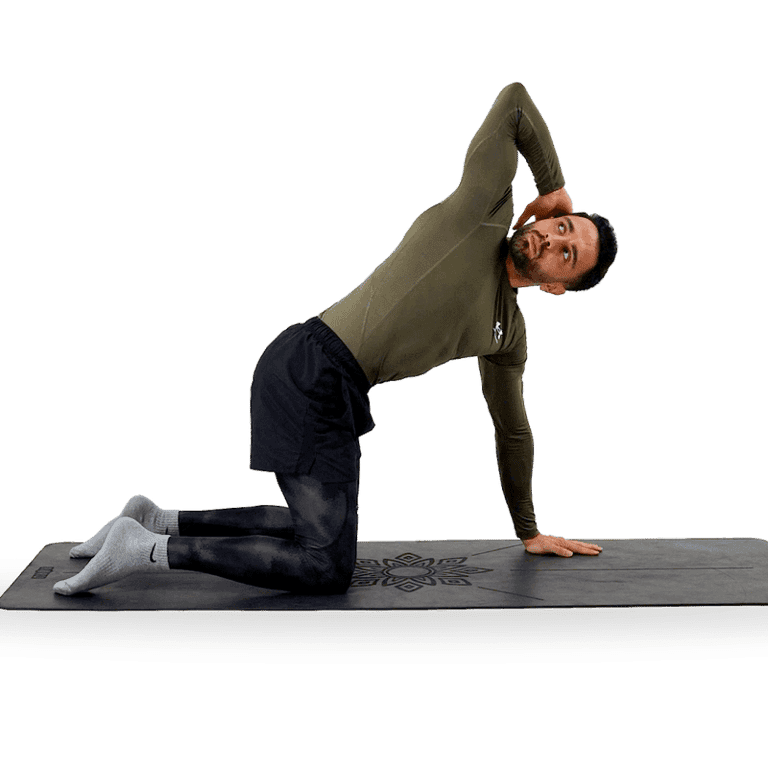
Is your breath going in and out in short bursts high in your chest? Belly breathing really means breathing with your diaphragm. Here is what the diaphragm moves with each breath and how to feel it in your own body.
Why does my upper back hurt at my desk, and what helps?
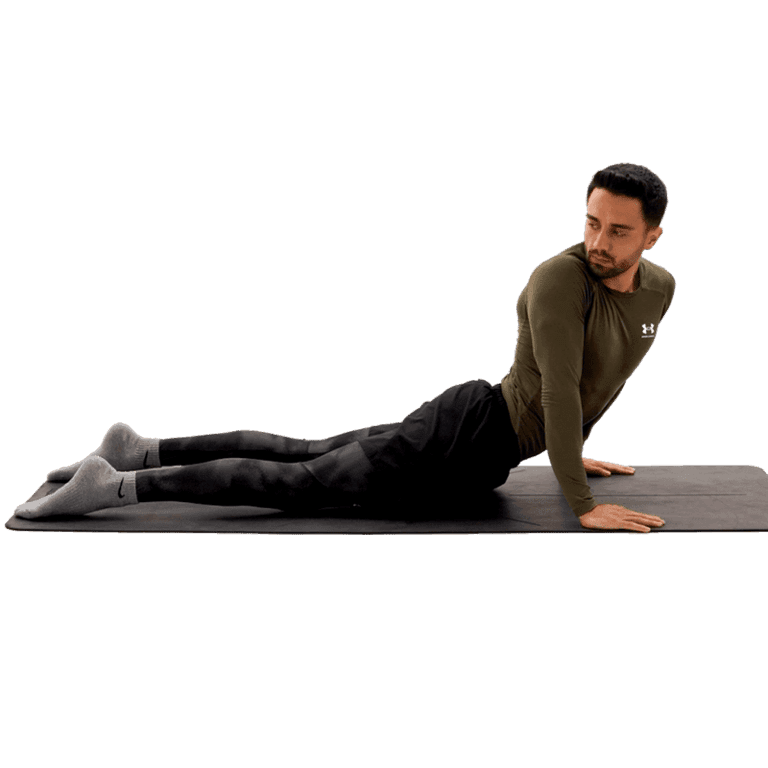
That evening heaviness between your shoulder blades may not be about sitting wrong, but about not moving for hours. How your upper back works and what you can try at the same desk.
How to breathe properly
There is no single right way to breathe; it depends on what you're doing. Why breathing in slowly and out for longer helps you calm down, how to breathe when you lift something heavy, and a one-minute breathing break.