
How to breathe properly
How should you breathe? What breathing in slowly and out for longer does to calm you down, and how to breathe when lifting something heavy and during the day.
Right before a meeting someone tells you to "take a deep breath". You do: your shoulders rise to your ears, your chest puffs up, and you don't feel any calmer.
Short answer: there is no single right way to breathe; it depends on what you're doing. During the day your breathing takes care of itself. When you want to calm down, what helps is not the size of the breath but its pace: around six breaths a minute, with the out-breath longer than the in-breath. Holding your breath briefly while you lift something heavy is normal.
How should you breathe to calm down?
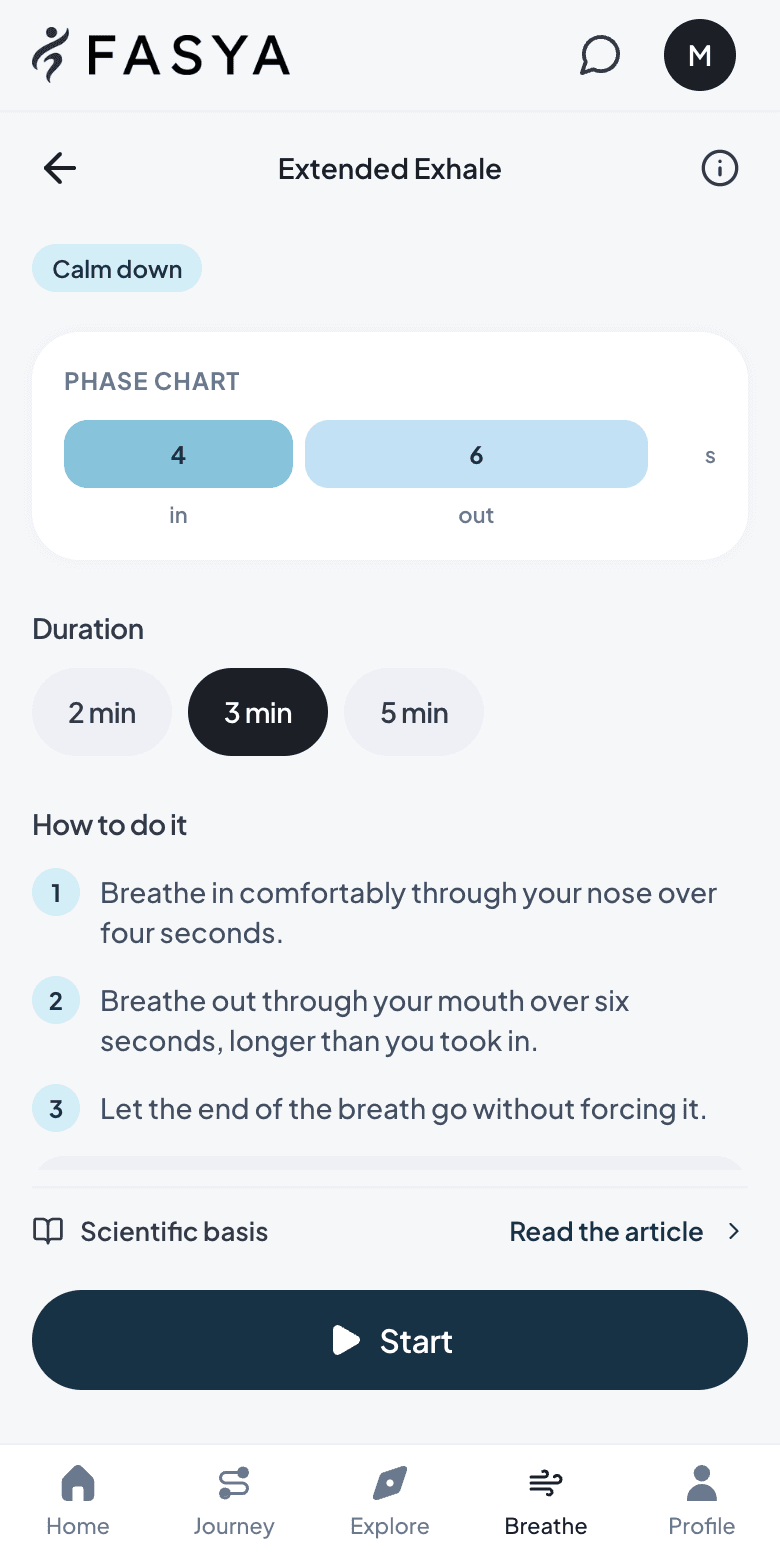
Breathe in slowly, breathe out for longer. In for a count of four, out for a count of six; that brings you to around six breaths a minute. Systematic reviews consistently show that breathing at this pace clearly increases heart rate variability, and that making the out-breath longer than the in-breath strengthens the effect. A meta-analysis pooling randomised controlled trials also found that breathwork brings a small to moderate reduction in stress and anxiety.
That's why the "deep breath" before a meeting sometimes does nothing: gulping a big, fast breath and letting it straight out looks nothing like the slow pace that worked in the studies.
This is a tool for calming down, not a treatment. There is no evidence that breathing changes your tissues or gets rid of back pain.
How should you breathe when lifting something heavy?
Holding your breath briefly while you lift something heavy is normal. Your main breathing muscle, the diaphragm, sits on top, the pelvic floor underneath and the deepest layer of your abdominal wall around the sides; they work together and support your spine as you move. The pelvic floor also switches on when you raise your arms or carry a load.
The problem is stretching that breath-hold across the whole day. Walking around with your belly pulled in and your breath held doesn't make you stronger. It just wears you out.
What does good breathing look like during the day?
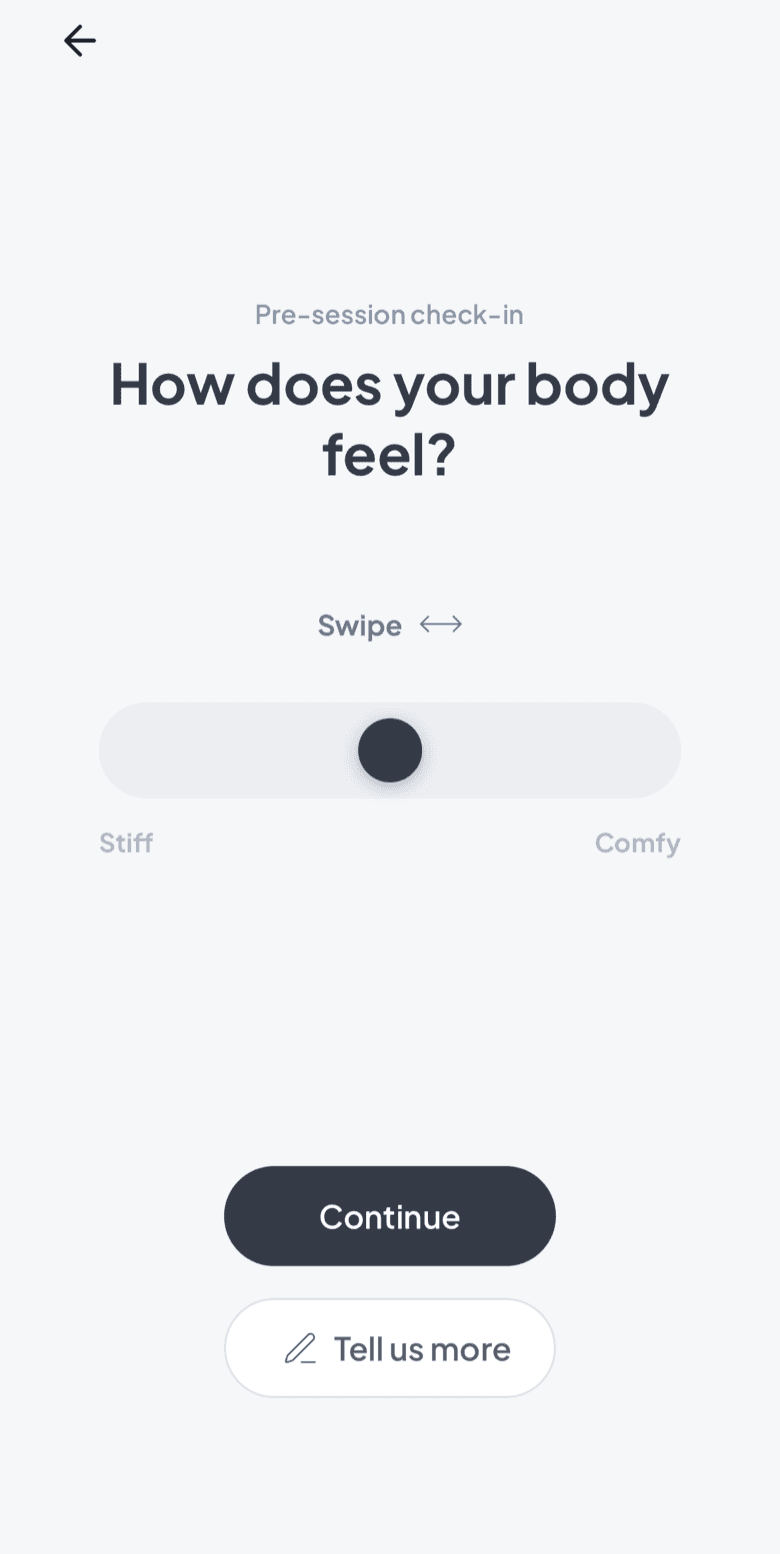
Most of the time you don't need to interfere with your breathing at all. The first step isn't learning a technique; it's noticing how you're breathing right now: chest or belly? Short or long? The sense that picks up signals from inside your body is called interoception, and it gets sharper the more attention you give it. Fasya is an app with a few minutes a day of mobility and breathing sessions; its Extended Exhale technique follows exactly this in-for-four, out-for-six pace. At the start of every session it also asks how your body feels.
How do you take a one-minute breathing break?
- Sit down and rest your hands on both sides of your lower ribs.
- Breathe in through your nose for a count of four; let your hands move outwards without your shoulders lifting.
- Breathe out slowly for a count of six.
- Repeat for one minute.
How much? One minute a few times a day is a good start. This isn't a prescription; how quickly it relaxes you, and how much you need, varies from person to person. If these counts feel hard, breathing in for three and out for five works too; what matters is that the out-breath lasts longer than the in-breath.
Frequently asked questions
- How do you breathe properly?
- It depends on the situation. During the day your breathing takes care of itself; to calm down, a slow pace such as in for four and out for six works; when lifting something heavy, holding your breath briefly is normal.
- How many minutes should I do breathing exercises?
- There is no fixed amount. One minute a few times a day is a good start; how much is enough varies from person to person.
- Do breathing exercises help with anxiety?
- They help you calm down. A meta-analysis pooling randomised controlled trials found that breathwork brings a small to moderate reduction in stress and anxiety. It doesn't replace treatment.
- Do breathing exercises help with back pain?
- There is no solid evidence for that. The effect of slow breathing on calming down and on stress has been measured, but there is no evidence that it gets rid of pain.
Sources
Sources are taken from the expert-reviewed content cards in Fasya's knowledge base.
- How breath-control can change your life: a systematic review on psycho-physiological correlates of slow breathing — Zaccaro A, et al., 2018
- Effects of voluntary slow breathing on heart rate and heart rate variability: A systematic review and a meta-analysis — Laborde S, Allen MS, Borges U, et al., 2022
- The physiological effects of slow breathing in the healthy human — Russo MA, Santarelli DM, O'Rourke D, 2017
- Effect of breathwork on stress and mental health: A meta-analysis of randomised-controlled trials — Fincham GW, Strauss C, Montero-Marin J, Cavanagh K, 2023
- Postural and respiratory functions of the pelvic floor muscles — Hodges PW, Sapsford R, Pengel LHM, 2007
- Inefficient muscular stabilization of the lumbar spine associated with low back pain — Hodges PW, Richardson CA, 1996
- How do you feel? Interoception: the sense of the physiological condition of the body — Craig AD, 2002
- Chest Pain in Focal Musculoskeletal Disorders — Stochkendahl MJ, Christensen HW, 2010
- Evaluation and Treatment of Musculoskeletal Chest Pain — Ayloo A, Cvengros T, Marella S, 2013
This article is for information only; it does not diagnose and is no substitute for an examination. If your symptoms persist, see a clinician.
Related articles
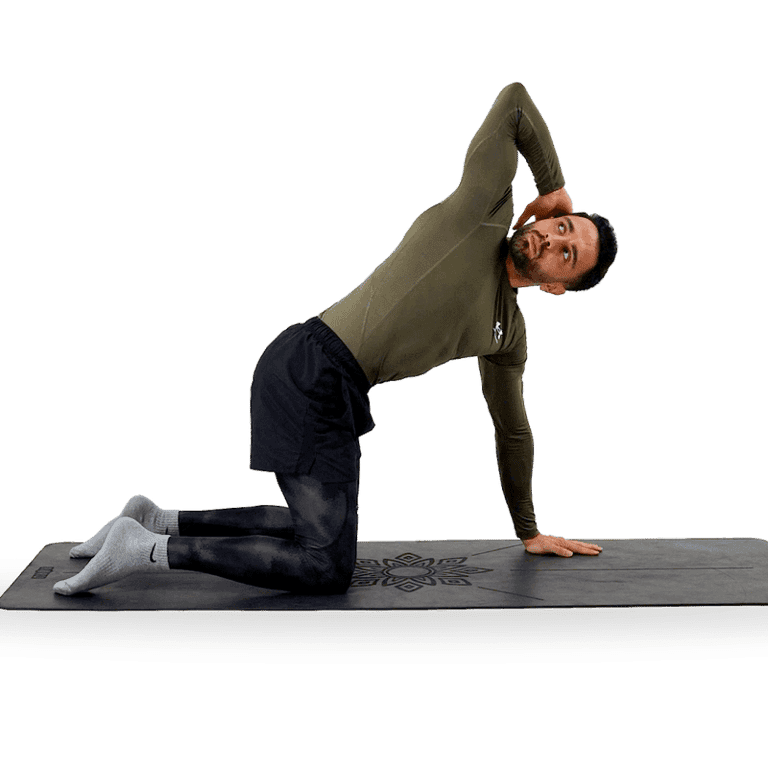
Do you breathe from your chest or your belly?
Is your breath going in and out in short bursts high in your chest? Belly breathing really means breathing with your diaphragm. Here is what the diaphragm moves with each breath and how to feel it in your own body.
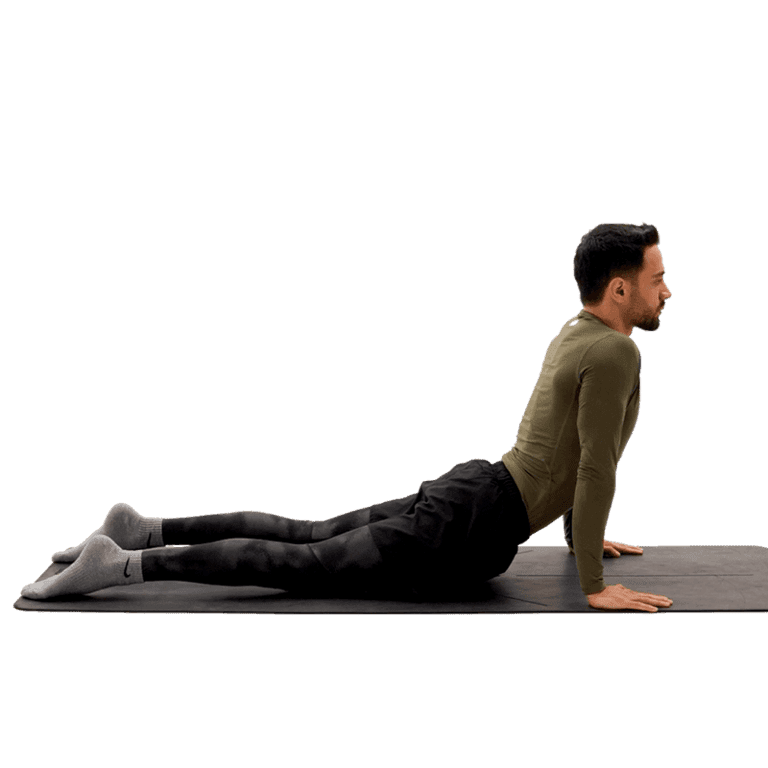
Why does stress stay in the body as tension?
At the end of a hard week your shoulders are up by your ears and your jaw is clenched. How stress shows up in the body, whether fascia plays a part, where the idea that "emotions are stored in tissue" leaves the evidence behind, and small ways to interrupt the tension.
How does slouching affect your body?
Hunch over a screen for hours and your breath seems to catch somewhere. How slouching affects your breathing, neck and lower back, where the evidence is clear and where it's blurry, and a simple way to open your ribcage.