
Do you breathe from your chest or your belly?
What chest breathing means, why belly breathing gets recommended, and how the diaphragm moves your ribs, belly pressure and pelvic floor with every breath.
A difficult email on the screen, your shoulders creeping up towards your ears. Then you notice it: for the last few minutes your breath has been going in and out in short bursts high in your chest. Your belly hasn't moved at all.
Short answer: "belly breathing" really means breathing with your diaphragm. The diaphragm is your main breathing muscle, a dome that separates your chest from your abdomen. When it drops as you breathe in, your belly moves forward a little and your ribs widen to the sides. If your breath keeps bouncing around the top of your chest, the diaphragm is doing less of the work. That happens to everyone now and then; noticing it is the first step to changing it.
What does the diaphragm do when you breathe?
As you breathe in, the diaphragm contracts and moves down, making room inside the ribcage; as you breathe out, it relaxes and rises again. According to anatomy textbooks it does this roughly twenty thousand times a day.
Its job doesn't stop at filling your lungs. When the diaphragm drops, pressure inside your abdomen rises a little, and the layer of muscle across the bottom of your pelvis (the pelvic floor) answers by lengthening slightly; as you breathe out, the two gather back up together. Diaphragm on top, pelvic floor underneath, the deepest layer of your abdominal wall around the sides: a team that gently supports your spine while you move. Every breath is a small movement of your whole trunk.
The back ends of the diaphragm reach down to the upper vertebrae of your lower back, so this muscle is a neighbour of your lower back. Some sources take this further and say "every breath loads the back and hip muscles". How much that connection matters for everyday pain, though, nobody has actually measured.
Why do we breathe from the chest?
Two ordinary reasons stand out during the day. The first is how you sit: when you stay hunched over for a long time, the front of your ribcage closes and your breath gets shallow. The second is tension: a busy mind either doesn't hear signals from the body at all or reads every one of them as an alarm, and you simply stop noticing where your breath is going.
The third is a habit that looks harmless on paper: holding your stomach in all day. Holding your breath briefly while you lift something heavy is normal. Walking around for the rest of the day with your belly pulled in and your breath held doesn't make you stronger. It just wears you out.
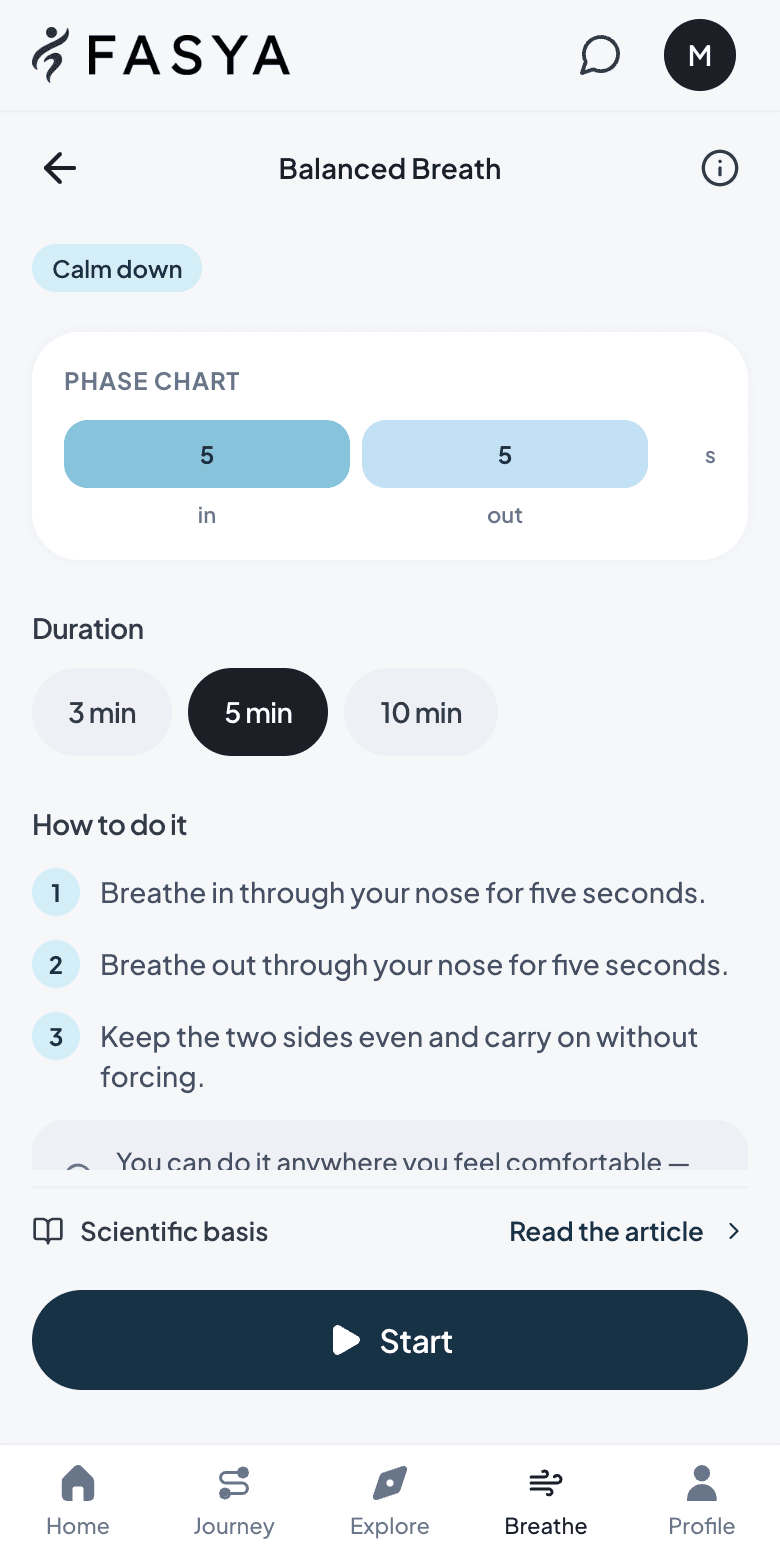
If you want to try a calm, even rhythm, the Balanced Breath technique in the app walks you through breathing in for five seconds and out for five.
How can you feel your diaphragm moving?
One try is enough.
- Sit down and rest your hands on both sides of your lower ribs.
- Breathe in slowly through your nose; let your hands move outwards without your shoulders lifting.
- Breathe out for a little longer than you breathed in. Five or six rounds are plenty.
If your hands barely move, don't worry about it; the point is to see where your breath goes. We cover the pace to breathe at when you want to calm down in the article on breathing properly. Fasya is an app built around short mobility and breathing sessions, and before every session it asks how your body feels. You can do this little test right before answering that question.
Frequently asked questions
- Is chest breathing bad for you?
- Breathing from your chest now and then is normal. If it goes on all day, it's a good habit to notice it and bring your diaphragm back in with a few slow breaths. Shortness of breath that continues even at rest is something to ask a doctor about.
- What does the diaphragm do?
- The diaphragm is the main muscle you breathe with: it contracts and moves down to make room for your lungs. Along the way it widens your ribs, changes the pressure inside your abdomen and works together with your pelvic floor.
- Do the diaphragm and pelvic floor work together?
- Yes. When you breathe in, the diaphragm drops, pressure in your abdomen rises and the pelvic floor lengthens slightly; when you breathe out, the two gather back up together. The pelvic floor also switches on when you raise your arms or carry a load.
Sources
Sources are taken from the expert-reviewed content cards in Fasya's knowledge base.
- Clinically Oriented Anatomy, 8th edition — Moore KL, Dalley AF, Agur AMR, 2018
- Postural and respiratory functions of the pelvic floor muscles — Hodges PW, Sapsford R, Pengel LHM, 2007
- The sacroiliac joint: an overview of its anatomy, function and potential clinical implications — Vleeming A, Schuenke MD, Masi AT, Carreiro JE, Danneels L, Willard FH, 2012
- Inefficient muscular stabilization of the lumbar spine associated with low back pain — Hodges PW, Richardson CA, 1996
- How do you feel? Interoception: the sense of the physiological condition of the body — Craig AD, 2002
- Chest Pain in Focal Musculoskeletal Disorders — Stochkendahl MJ, Christensen HW, 2010
- Evaluation and Treatment of Musculoskeletal Chest Pain — Ayloo A, Cvengros T, Marella S, 2013
This article is for information only; it does not diagnose and is no substitute for an examination. If your symptoms persist, see a clinician.
Related articles
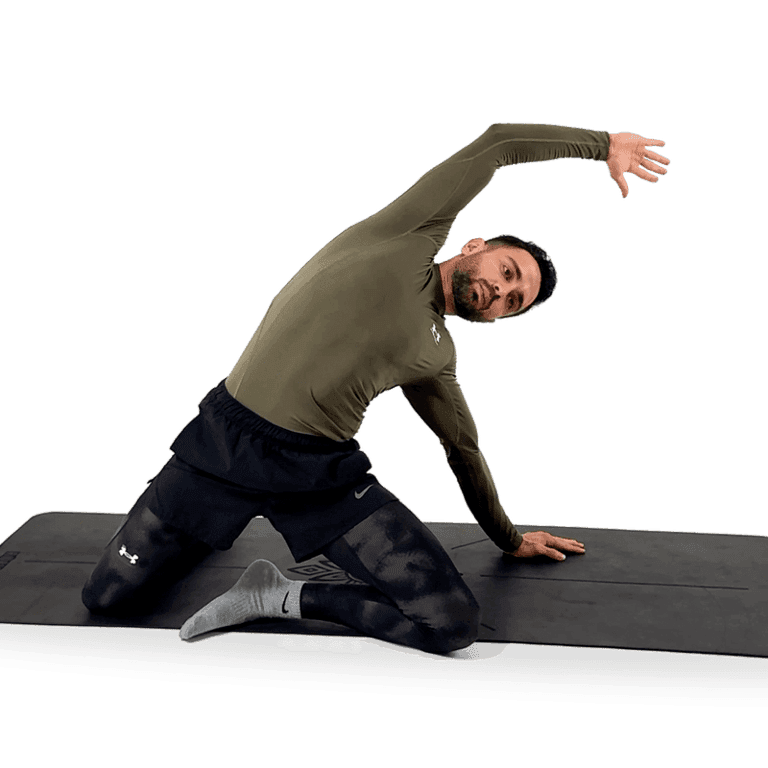
How to breathe properly
There is no single right way to breathe; it depends on what you're doing. Why breathing in slowly and out for longer helps you calm down, how to breathe when you lift something heavy, and a one-minute breathing break.
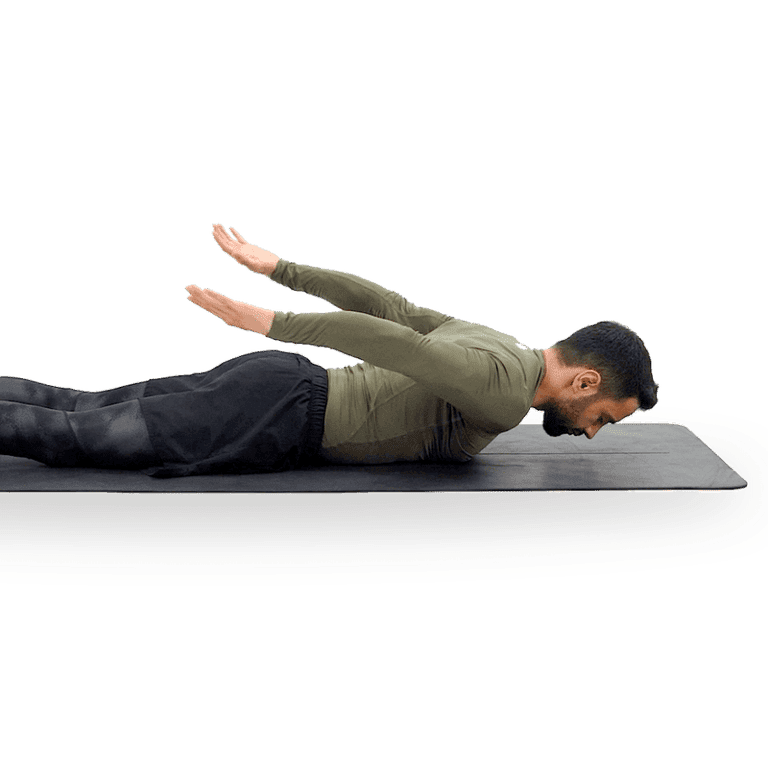
How does slouching affect your body?
Hunch over a screen for hours and your breath seems to catch somewhere. How slouching affects your breathing, neck and lower back, where the evidence is clear and where it's blurry, and a simple way to open your ribcage.
Why does stress stay in the body as tension?
At the end of a hard week your shoulders are up by your ears and your jaw is clenched. How stress shows up in the body, whether fascia plays a part, where the idea that "emotions are stored in tissue" leaves the evidence behind, and small ways to interrupt the tension.