
Why does stress stay in the body as tension?
Does stress cause muscle tension? Why your shoulders stay up, the idea that emotions hide in fascia, and what slow breathing actually does.
Friday evening, as you send the last message of the week, you notice your shoulders are glued to your ears and your jaw is locked. You did not lift anything heavy, yet your body feels as if it has been carrying something all week.
You are not imagining it. Stress really does increase muscle tension: under mental load, muscles stay slightly contracted even when there is no physical work to do, and a nervous system on alert becomes more sensitive to pain. The tension does not pile up somewhere. It keeps going because it never gets a break.
How does stress show up in your muscles?
The clearest pathway is the muscle itself. In lab studies, while people do nothing but a mental task, without lifting anything, the electrical activity of the trapezius muscle at the top of the shoulder rises and does not settle as long as they stay focused. A low-level but uninterrupted contraction. For an hour it hardly matters; for a whole day it is a different story. A meta-analysis pooling long-term follow-up studies also found that psychosocial stress at work predicts neck and shoulder complaints months later.
The second pathway is how pain gets tuned. Your pain threshold is not a fixed number; it is a dial that moves during the day. In experiments, a single sleepless night lowers the pain threshold measurably, and the same stimulus hurts more when it is labelled "this could cause damage". A stressful week usually means little sleep and a lot of worry. That week, the same shoulder speaks up louder.
The third pathway is how you read signals from inside. The sense of noticing your heartbeat, your breath and your tension is called interoception. A hurried mind either does not hear these signals at all or reads every one of them as an alarm. The shoulder you notice in the evening was most likely up since lunchtime.
Does stress tighten fascia too?
Fascia is the web of connective tissue that wraps muscles and organs, and it is not a silent filler; it contains nerve endings that can carry pain. So part of what you feel in a tense shoulder may well come from the membrane around the muscle.
There is a more controversial idea as well. Fascia contains cells that can contract (myofibroblasts). Some researchers have shown in lab tissue samples that stress-related signals can increase how much these cells contract, and they suggest that stress may tighten fascia too. Interesting, but a hypothesis. How strong this contraction is in a living body, and how much of everyday tension it explains, is not known. The sturdier explanation we have today is the muscle's uninterrupted activity and the tuning of the nervous system.
Are emotions stored in fascia?
Some people suddenly start crying on the massage table. Others feel an unexpected sadness after a long stretch. These are real experiences, and there is nothing to dismiss about them.
The popular explanation goes like this: trauma and emotions are "stored" in fascia and come out when the tissue lets go. This idea has not been proven. No study shows tissue holding on to a memory or an emotion and releasing it later. "Stress builds up in your tissues" is a metaphor, not a mechanism.
So where do those tears come from? We do not know for sure. The likely explanations are more ordinary: a moment of feeling safe in a body that has been on alert for a long time, breathing that slows down, attention turning inward for the first time in ages. Feeling an emotion in your body is real. That its address is a memory hidden in tissue is an assumption.
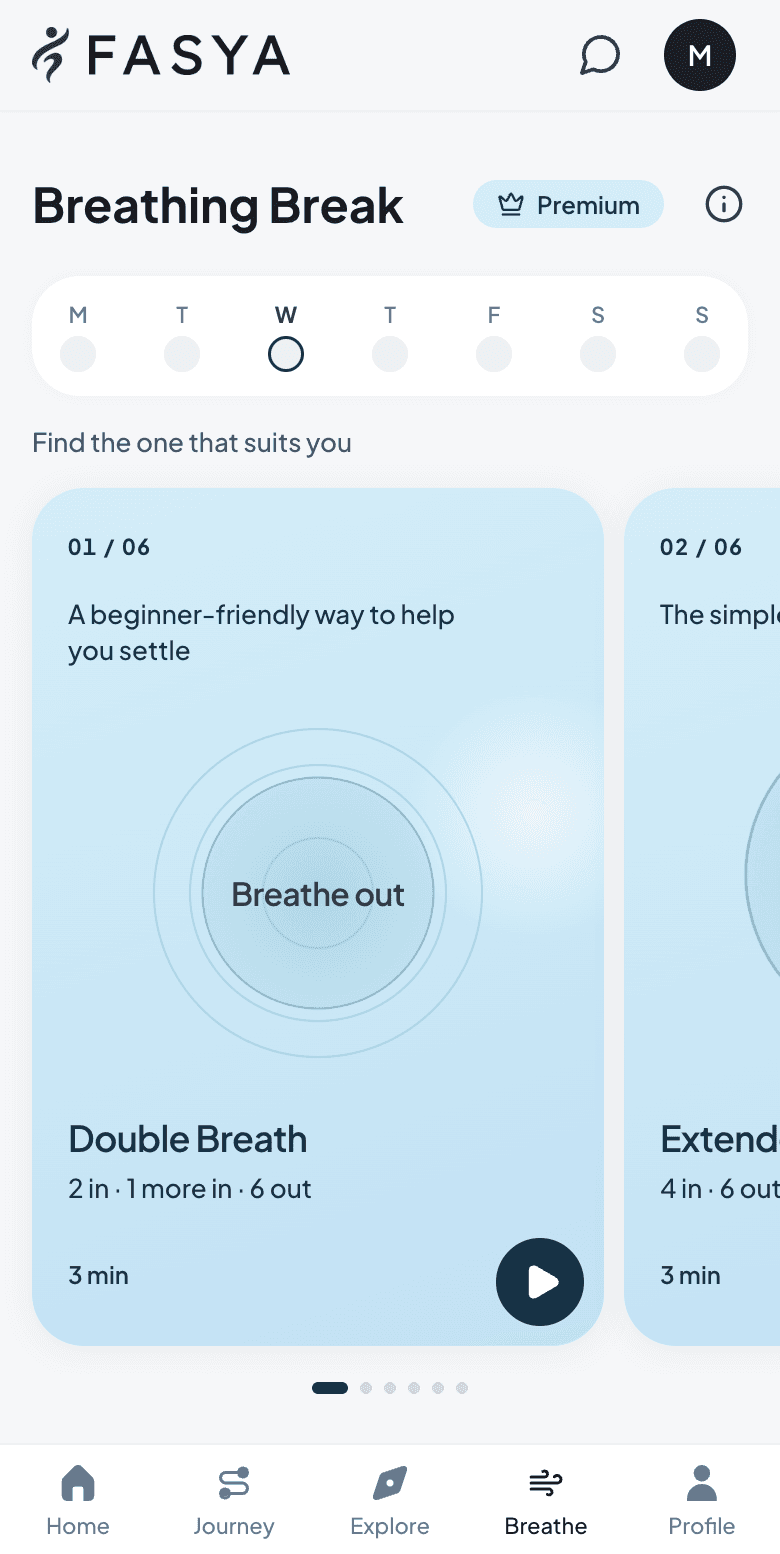
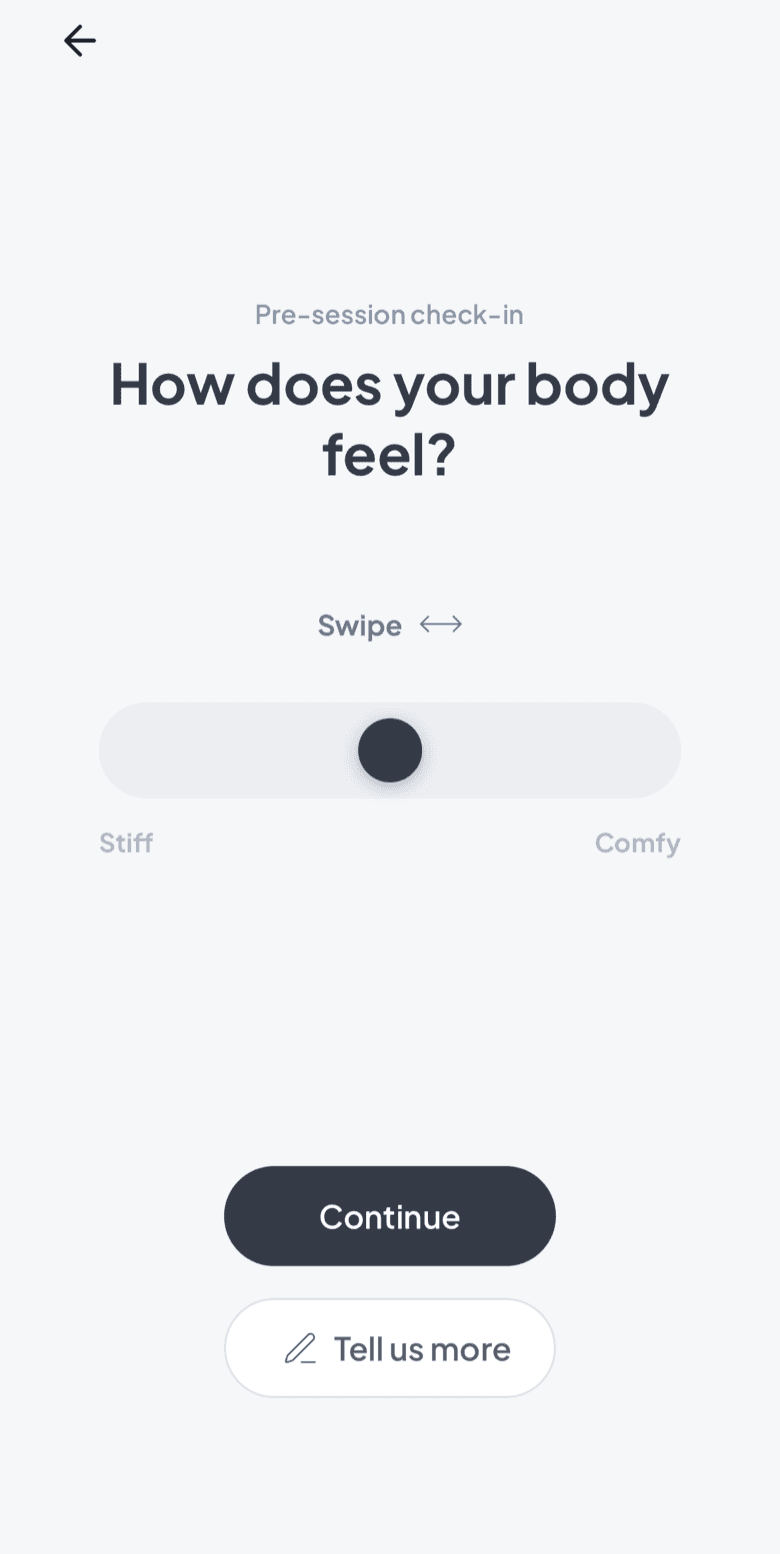
The practical lesson is simple: the first thing to do with tension is to notice it. Fasya is an app that offers mobility and breathing sessions of a few minutes a day, and at the start of each session it asks how your body feels.
What helps with stress tension?
The goal is not to chase the tension away but to interrupt it. Four small tools:
- A long exhale. Breathe in for four counts, out for six. That brings you down to around six breaths a minute; this pace increases heart rate variability, and lengthening the exhale strengthens the effect. A meta-analysis pooling randomised controlled trials found that breathwork brings a small to moderate reduction in stress and anxiety. A tool for calming down, not a treatment. The Extended Exhale technique in the app follows this pace; we walk through it step by step in the article on breathing properly.
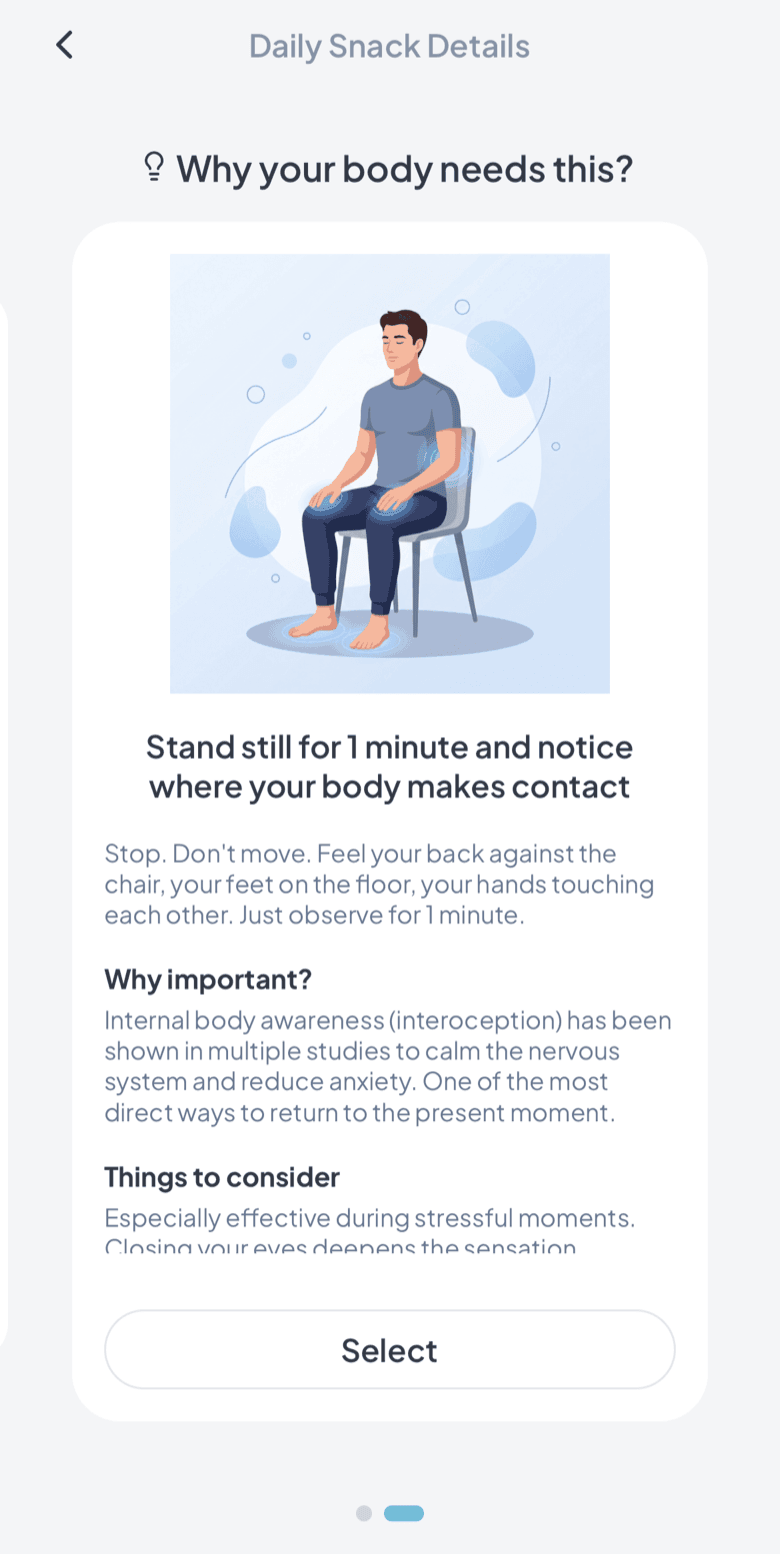
- A body scan. Sit down and move your attention in turn to your jaw, your shoulders, your belly, your hands. Name what you find without grading it: tight, raised, warm, heavy. This is interoception in practice; the ability to notice signals from inside gets stronger the more attention you give it.
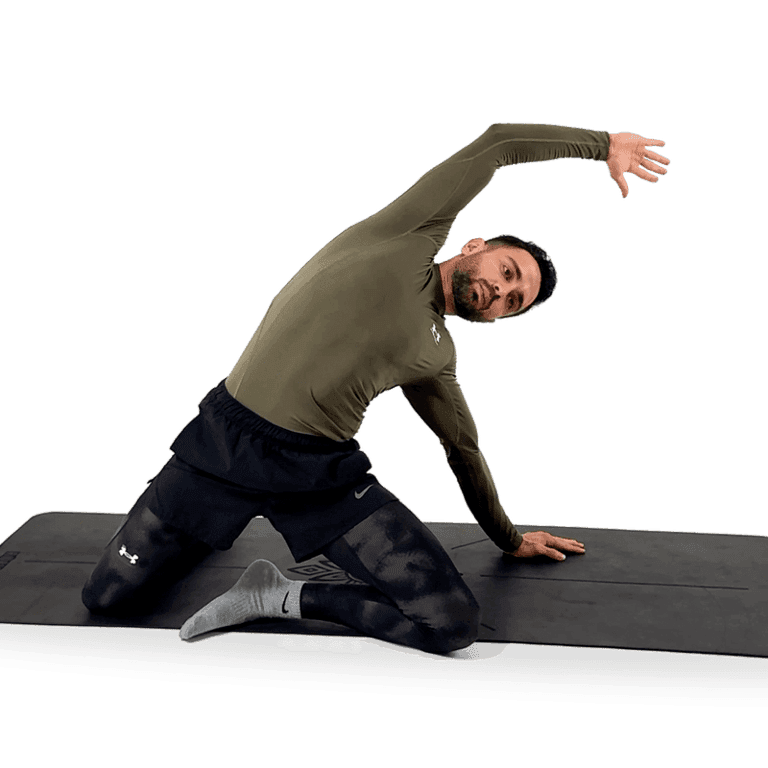
- A movement break every hour. Lift your shoulders and drop them, squeeze your shoulder blades together and open them, turn your head to both sides, change how you are sitting. One minute is enough.
- A small, safe dose. A body expecting a threat stiffens and its movement narrows. Some studies show that pushing through is not necessary: painful exercises give only a small advantage in the short term, and the difference disappears in the medium and long term. People who feel understood and safe also get better results. Do not drop a movement you are afraid of entirely; make it smaller, repeat it for a few days, then make it a little bigger.
How much? For breathing, one minute a few times a day; for the scan, sixty seconds; for movement, one minute every hour. That is a good start. These are not prescriptions. Nobody can tell you which one will help you relax, or how quickly; it varies from person to person.
And then there are bad days. After a whole week of going well, you might wake up one morning with your shoulders like stone again. That does not mean you have gone backwards. Tension and pain rise and fall with sleep, load and worry; the line is not straight, it is jagged like a saw.
In short
Stress really does create tension in the body: muscles stay contracted under mental load, the pain threshold drops, and signals from inside get read as alarms. Fascia may play a part in this picture too, but that is still a hypothesis; the idea that emotions are stored in tissue has not been proven. The sturdiest tools you have are small: one long exhale, a sixty-second scan, one minute of movement every hour.
Frequently asked questions
- Can stress cause muscle tension?
- Yes. Under mental load, even with no physical work at all, the electrical activity of the trapezius muscle in the shoulder rises and does not settle as long as you stay focused. The problem is not how hard the muscle contracts but that it keeps going, without a break, for hours.
- Where is stress stored in the body?
- It is not really stored anywhere; "stress builds up" is a metaphor. Tension is felt most often in the shoulders, neck and jaw, because these muscles keep working at a low level but without pause under mental load.
- Are emotions stored in fascia?
- There is no evidence for that. Experiences like crying during a massage are real, but it has not been shown that the cause is a memory hidden in tissue; more ordinary explanations, such as feeling safe and breathing more slowly, are also possible.
- Do breathing exercises help with stress?
- They help you calm down. A pace of around six breaths a minute with a long exhale increases heart rate variability, and breathwork brings a small to moderate reduction in stress and anxiety. It is not a treatment, but it is the quickest tool you have in a tense moment.
Sources
Sources are taken from the expert-reviewed content cards in Fasya's knowledge base.
- Psychophysiological stress and EMG activity of the trapezius muscle — Lundberg U, Kadefors R, Melin B, et al., 1994
- Psychosocial work stressors as antecedents of musculoskeletal problems: a systematic review and meta-analysis of stability-adjusted longitudinal studies — Lang J, Ochsmann E, Kraus T, Lang JWB, 2012
- The pain of sleep loss: a brain characterization in humans — Krause AJ, Prather AA, Wager TD, Lindquist MA, Walker MP, 2019
- The context of a noxious stimulus affects the pain it evokes — Moseley GL, Arntz A, 2007
- How do you feel? Interoception: the sense of the physiological condition of the body — Craig AD, 2002
- Sensory innervation of the thoracolumbar fascia in rats and humans — Tesarz J, Hoheisel U, Wiedenhöfer B, Mense S, 2011
- Effects of voluntary slow breathing on heart rate and heart rate variability: A systematic review and a meta-analysis — Laborde S, Allen MS, Borges U, et al., 2022
- The physiological effects of slow breathing in the healthy human — Russo MA, Santarelli DM, O'Rourke D, 2017
- Effect of breathwork on stress and mental health: A meta-analysis of randomised-controlled trials — Fincham GW, Strauss C, Montero-Marin J, Cavanagh K, 2023
- Moving differently in pain: a new theory to explain the adaptation to pain — Hodges PW, Tucker K, 2011
- Should exercises be painful in the management of chronic musculoskeletal pain? A systematic review and meta-analysis — Smith BE, Hendrick P, Smith TO, et al., 2017
- The Therapeutic Alliance Between Clinicians and Patients Predicts Outcome in Chronic Low Back Pain — Ferreira PH, Ferreira ML, Maher CG, et al., 2013
- Fear-avoidance and its consequences in chronic musculoskeletal pain: a state of the art — Vlaeyen JWS, Linton SJ, 2000
- Graded activity and graded exposure for persistent nonspecific low back pain: a systematic review — Macedo LG, Smeets RJEM, Maher CG, Latimer J, McAuley JH, 2010
This article is for information only; it does not diagnose and is no substitute for an examination. If your symptoms persist, see a clinician.
Related articles
How to breathe properly
There is no single right way to breathe; it depends on what you're doing. Why breathing in slowly and out for longer helps you calm down, how to breathe when you lift something heavy, and a one-minute breathing break.
What is that knot between your shoulder blades?
Feels like someone is pressing a fist between your shoulder blades? What that knot really is, how much stress has to do with it, and small breaks you can try without leaving your desk.
Do you breathe from your chest or your belly?
Is your breath going in and out in short bursts high in your chest? Belly breathing really means breathing with your diaphragm. Here is what the diaphragm moves with each breath and how to feel it in your own body.