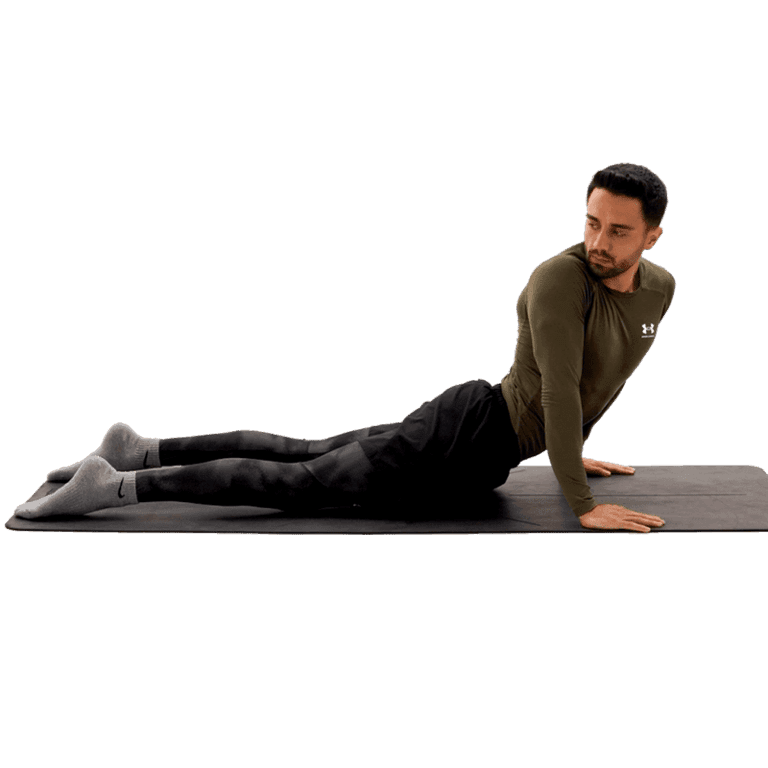
What is that knot between your shoulder blades?
A knot between the shoulder blades is the everyday name for a stubborn ache there. Why it happens, how stress plays in and what can help during the day.
Seven in the evening, the screen still on. It feels like someone is pressing a fist between your shoulder blades; you pull your shoulders back and it doesn't go away. Your mum would say you've got a knot back there.
A knot between the shoulder blades is the everyday name people give to a stubborn ache and stiffness in that spot. It's not a diagnosis, it's a description. Most of the time it's the ache of muscles that have grown tired after hours in the same position. Sometimes, though, the pain isn't coming from there at all but is referred from the neck.
What causes a knot between the shoulder blades?
The main player in this area is the trapezius muscle. It spreads from the back of your neck to your shoulders and down to the middle of your back like a kite; as long as your arms are out in front of you on the keyboard, it's the muscle holding your shoulder blades in place.
Stress plays a part too. In lab measurements, the electrical activity of the upper trapezius rises under mental load even when no physical work is being done, and it doesn't drop as long as attention is held. If your shoulders creep up towards your ears while you write a tricky email, you're not imagining it.
That said, "stress builds up in your muscles" is a metaphor. No substance piles up in the muscle; what happens is that a light contraction goes on for hours without a break. How exactly that unbroken effort turns into pain, we don't know yet.
How do you get rid of a knot between your shoulder blades?
Instinct says "stretch it", but that may not be the only way. In a randomised study of women with chronic neck and shoulder pain, ten weeks of weight training aimed directly at that muscle reduced pain more than general fitness training did. A tired muscle may be asking less for length and more for endurance.
During the day, the aim is not to chase the tension but to break the continuity:
- Get up for a minute every hour; lift your shoulders towards your ears and let them drop.
- Draw your shoulder blades back and down towards each other a few times.
- Take a few slow breaths through your nose and let your shoulders soften as you breathe out.
- Change how you sit. There is no single right position.
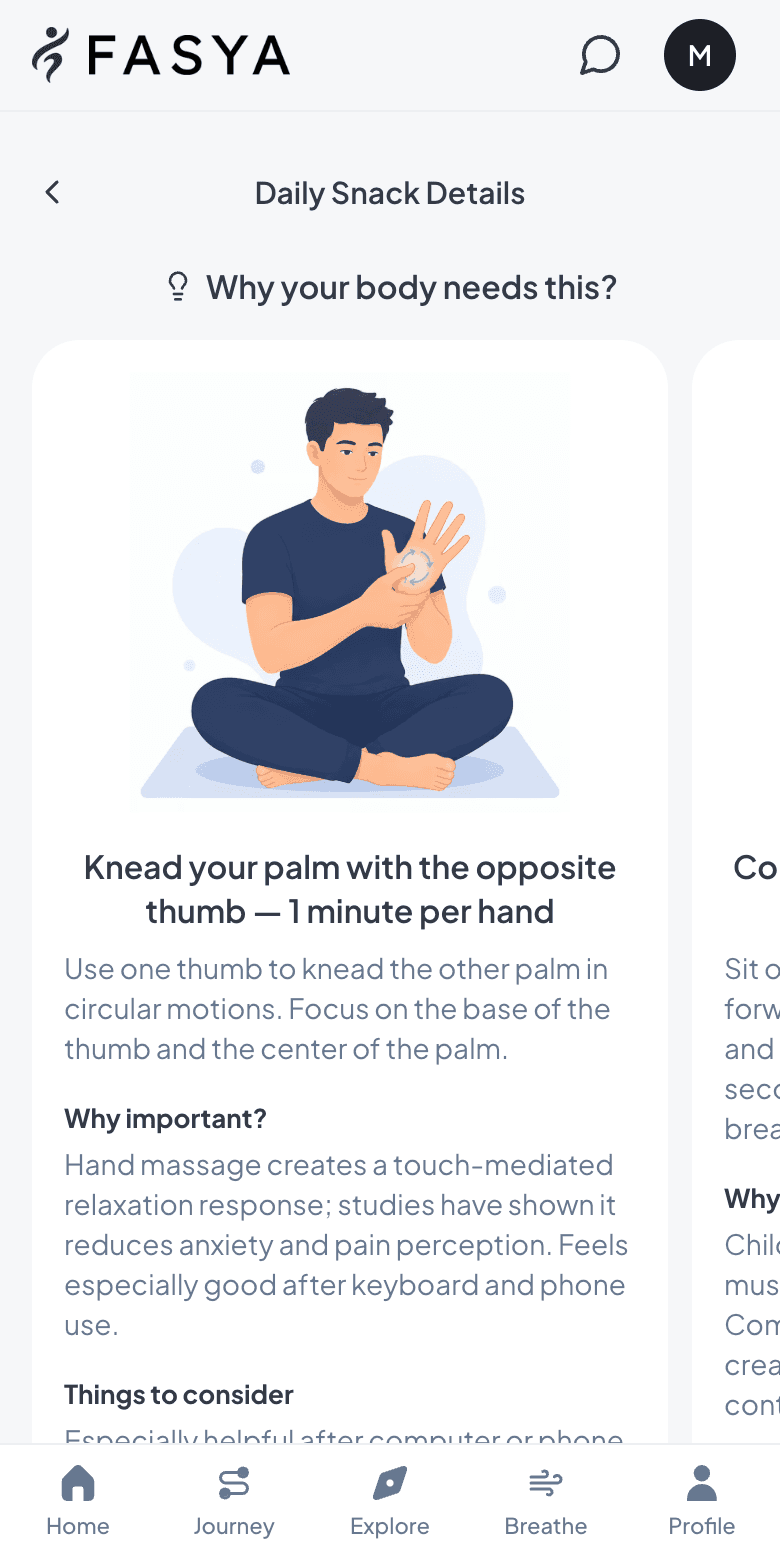
The hard part isn't the movement, it's remembering. Fasya is a mobility app that suggests a few minutes of movement a day; it's one of the tools you can use to spread these breaks across your day.
Frequently asked questions
- Can stress cause a knot between the shoulder blades?
- Stress alone doesn't cause one, but it can play a part. Under mental load the activity of the shoulder muscles goes up, and in long follow-up studies work stress predicts neck and shoulder complaints months later.
- Is a knot between the shoulder blades dangerous?
- Usually not; it's generally the ache of tired muscles. If it comes with chest pressure, pain spreading to your arm or jaw, shortness of breath or cold sweats, go to the emergency department without waiting.
- Should I stretch a knot between my shoulder blades or strengthen it?
- Stretching can bring quick relief, but it's not the only option. In one study ten weeks of weight training aimed at that muscle reduced pain more; short breaks scattered through the day also seem to help reduce new pain.
Sources
Sources are taken from the expert-reviewed content cards in Fasya's knowledge base.
- On the definitions and physiology of back pain, referred pain, and radicular pain — Bogduk N, 2009
- Clinically Oriented Anatomy, 8th edition — Moore KL, Dalley AF, Agur AMR, 2018
- Psychophysiological stress and EMG activity of the trapezius muscle — Lundberg U, Kadefors R, Melin B, et al., 1994
- Psychosocial work stressors as antecedents of musculoskeletal problems: a systematic review and meta-analysis of stability-adjusted longitudinal studies — Lang J, Ochsmann E, Kraus T, Lang JWB, 2012
- Computer work and musculoskeletal disorders of the neck and upper extremity: a systematic review — Wærsted M, Hanvold TN, Veiersted KB, 2010
- Effect of two contrasting types of physical exercise on chronic neck muscle pain — Andersen LL, Kjaer M, Søgaard K, Hansen L, Kryger AI, Sjøgaard G, 2008
- Effects of an active break and postural shift intervention on preventing neck and low-back pain among high-risk office workers: a 3-arm cluster-randomized controlled trial — Waongenngarm P, van der Beek AJ, Akkarakittichoke N, Janwantanakul P, 2021
- International Framework for Red Flags for Potential Serious Spinal Pathologies — Finucane LM, Downie A, Mercer C, et al., 2020
- 2021 AHA/ACC/ASE/CHEST/SAEM/SCCT/SCMR Guideline for the Evaluation and Diagnosis of Chest Pain — Gulati M, Levy PD, Mukherjee D, et al., 2021
- Diagnosing acute aortic syndrome: a Canadian clinical practice guideline — Ohle R, Yan JW, Yadav K, et al., 2020
This article is for information only; it does not diagnose and is no substitute for an examination. If your symptoms persist, see a clinician.