Why does my upper back hurt at my desk, and what helps?
Upper back pain at a desk usually comes from staying in one position for hours, not from bad posture. Causes, what to try at your desk and the warning signs.
It's nearly five. One last spreadsheet on the screen, shoulders drifting forward, and that familiar heaviness between your shoulder blades. Upper back pain at a desk is usually not the result of one "bad posture" but of holding the same position for hours. With your arms out front and your head turned to the screen, the muscles of your upper back work lightly but without a break. So the first fix isn't a new chair. It's changing shape more often during the day.
Why does my upper back hurt at my desk?
You're not alone. A systematic review of studies in the general population found that the share of people with upper back pain over a year ranged from 3.5% to 34.8%, depending on the study.
Here's what happens at the desk. With your arms on the keyboard and your head reaching toward the screen, the muscles in your upper back and around your shoulder blades work at a low intensity. It isn't a heavy load. But it never stops; the same small muscle fibres stay switched on for hours. That tired, heavy feeling toward the evening most likely comes from there.
So, "am I sitting wrong?" The honest answer: research doesn't agree on which way of sitting leads to pain. The stronger clue we have is not the shape of your sitting but how long it lasts. No need to blame yourself.
Can upper back stiffness spread to the neck and shoulder?
Your upper back is made of the twelve vertebrae between your neck and your lower back, and each one has a pair of ribs attached. Its specialty is rotation, but it doesn't do it from a single point: each vertebra turns only 1 to 3 degrees relative to the one below, and added together the trunk reaches an average of 25 degrees. A partnership of small shares. If one section stays still for hours, its share lands on the neighbours: the neck above, the lower back below.
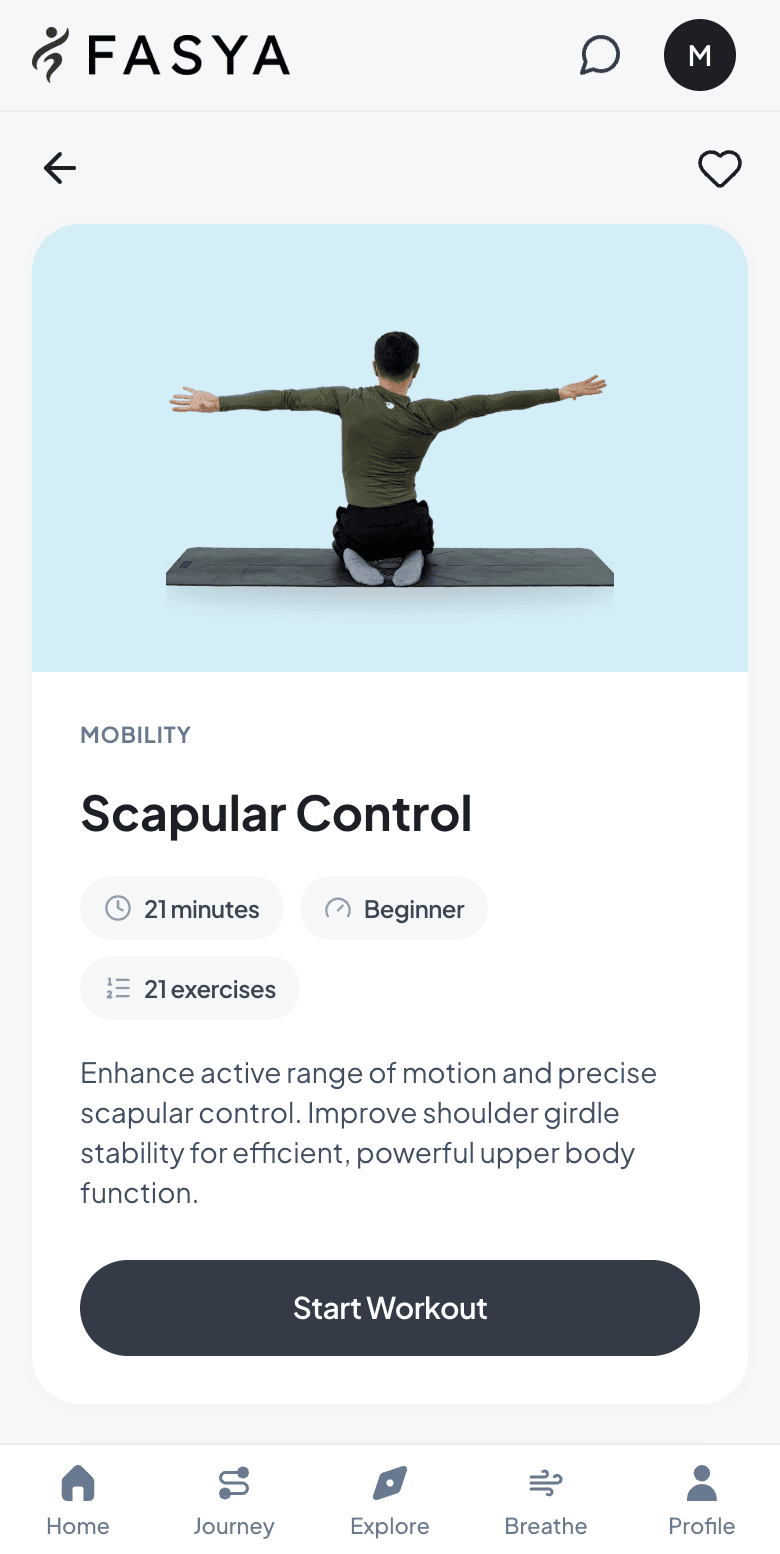
There's a similar clue on the shoulder side. In one study, when volunteers raised their arms out to the side while sitting slumped, they could lift them on average 23 degrees less than when sitting upright. That doesn't prove your upper back is the cause of your neck or shoulder pain; it shows that the regions influence each other. So it makes sense to treat the upper back together with its neighbours, not on its own. The Scapular Control workout in the app trains the upper back and shoulder blade together with the shoulder. We cover how slumped sitting affects your breathing in our post on slouching.
What helps upper back pain at a desk?
The goal isn't perfect posture, it's spending less time in one position. Things you can try at the same desk:
- Get up once an hour. Grabbing water or taking a call standing up counts.
- Change shape while you sit. Lean back, lean forward, shift your weight from side to side. The best sitting position is the next one.
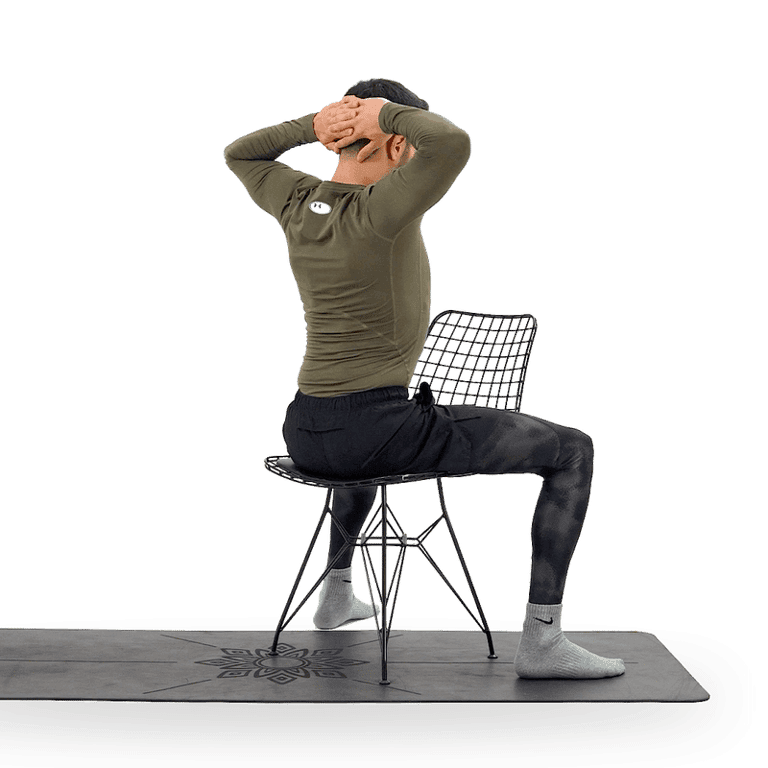
- Rotate your upper back. Cross your arms over your chest and slowly turn your trunk right and left. Your upper back is built to rotate; let it do that a few times a day.
- Lengthen your back before raising your arm. Before reaching for a high shelf, lift your chest slightly and turn a little. Some people notice the shoulder rises more easily this way.
- Take a few slow breaths. With every breath your ribs move at the joints of your upper back; a deep breath may be a way to move your back without getting up.
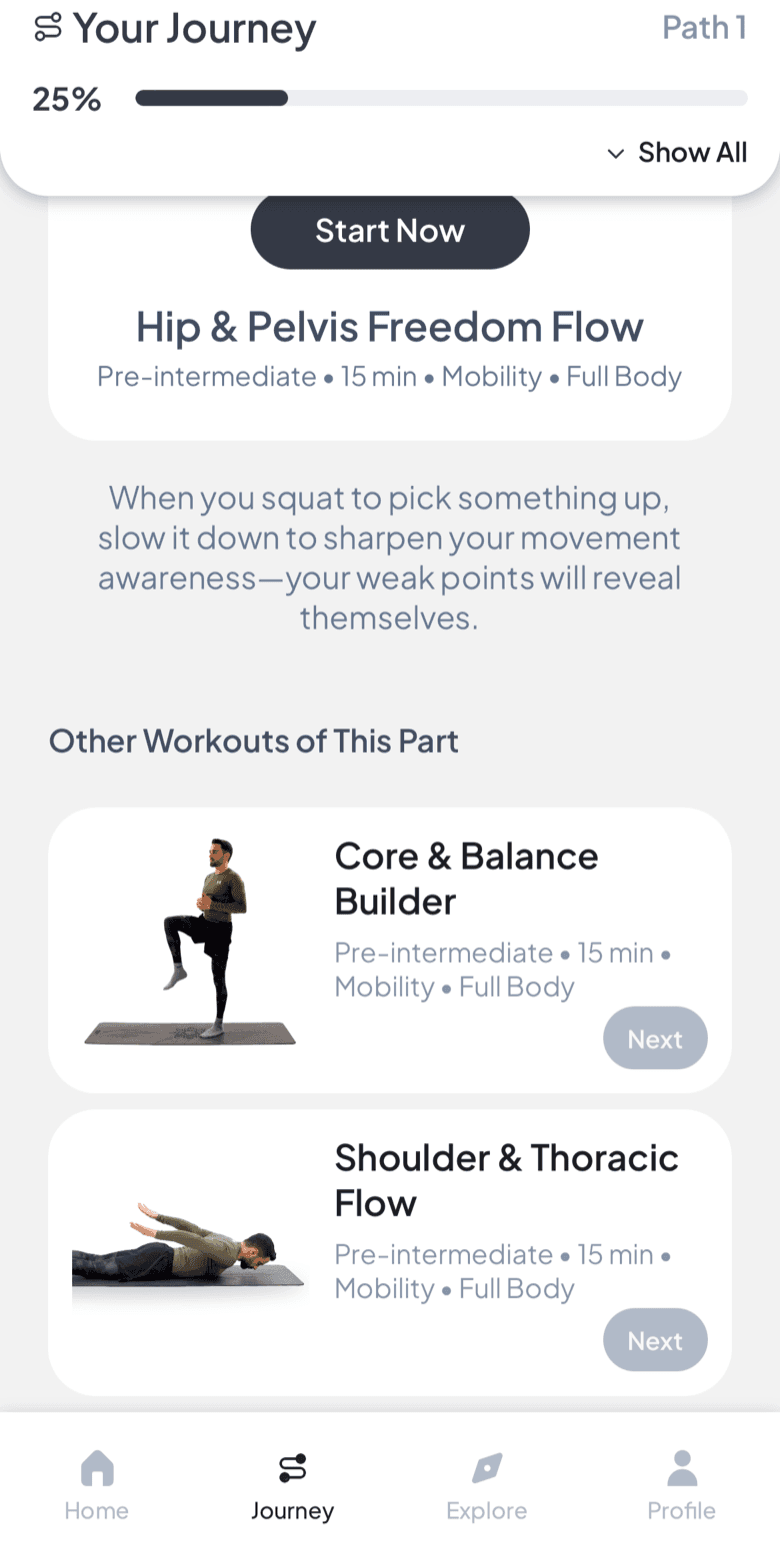
Fasya is an app built around mobility and flexibility; its Personal Journey trains the upper back together with the neck and shoulder in sequenced workouts. You can do the list above without the app too. How many times a day you repeat it seems to matter more than which move you pick.
Frequently asked questions
- Is upper back pain from sitting at a desk normal?
- It's quite common: in one review, the yearly rate of upper back pain ranged from 3.5% to 34.8% depending on the study. At a desk it mostly comes from tired muscles that work for hours without a break, and it usually isn't dangerous.
- Does sitting up straight prevent upper back pain?
- There's no clear evidence that it does on its own; research doesn't agree on which way of sitting leads to pain. How long you stay in the same position seems to matter more than the shape of your sitting.
- Is upper back pain linked to neck and shoulder pain?
- It can be; the upper back is the base the neck and shoulder rest on. When it moves less, part of the load shifts to the neighbouring regions, but that doesn't mean your upper back is necessarily the cause of your neck pain.
Sources
Sources are taken from the expert-reviewed content cards in Fasya's knowledge base.
- Thoracic spine pain in the general population: prevalence, incidence and associated factors in children, adolescents and adults. A systematic review — Briggs AM, Smith AJ, Straker LM, Bragge P, 2009
- Pathophysiology of upper extremity muscle disorders — Visser B, van Dieën JH, 2006
- No consensus on causality of spine postures or physical exposure and low back pain: A systematic review of systematic reviews — Swain CTV, Pan F, Owen PJ, Schmidt H, Belavy DL, 2020
- Kinematics of the Thoracic Spine in Trunk Rotation: In Vivo 3-Dimensional Analysis — Fujimori T, Iwasaki M, Nagamoto Y, et al., 2012
- Clinically Oriented Anatomy, 8th edition — Moore KL, Dalley AF, Agur AMR, 2018
- Thoracic position effect on shoulder range of motion, strength, and three-dimensional scapular kinematics — Kebaetse M, McClure P, Pratt NA, 1999
- Thoracic Spine Thrust Manipulation Improves Pain, Range of Motion, and Self-Reported Function in Patients With Mechanical Neck Pain: A Systematic Review — Cross KM, Kuenze C, Grindstaff TL, Hertel J, 2011
- International Framework for Red Flags for Potential Serious Spinal Pathologies — Finucane LM, Downie A, Mercer C, et al., 2020
- 2021 AHA/ACC/ASE/CHEST/SAEM/SCCT/SCMR Guideline for the Evaluation and Diagnosis of Chest Pain — Gulati M, Levy PD, Mukherjee D, et al., 2021
- Diagnosing acute aortic syndrome: a Canadian clinical practice guideline — Ohle R, Yan JW, Yadav K, et al., 2020
This article is for information only; it does not diagnose and is no substitute for an examination. If your symptoms persist, see a clinician.