
Your lower back hurts. Could the problem be your hips?
Can tight hips cause lower back pain? How the lower back and hips meet in one fascial layer, when training the neighbour helps, and where the evidence ends.
You lift the laundry basket off the floor and your lower back aches. The video you watched last night points somewhere else: "The problem isn't your back, your hips are tight."
The short answer: it is possible, but not certain. The lower back and hips share the work when you bend forward, and a hip muscle and a back muscle meet in the same lower back fascia. Training the neighbouring region sometimes reduces pain. But the evidence behind "your hips are the real culprit" is weak. Working on your hips is worth a try, but it is too early to name them the only culprit.
How are the lower back and hips connected?
Muscles are not parts that work independently of each other. The connective tissue that wraps a muscle (fascia) continues without a break into the sheaths of neighbouring muscles, and a measurable share of a contracting muscle's force passes to the ones next to it.
Where the lower back meets the upper back there is a broad, diamond-shaped layer of fascia (the thoracolumbar fascia). The large back muscle that connects the arm to the trunk and the big buttock muscle meet in this layer; the back muscle from one side, the buttock muscle from the opposite side. So this layer acts like a bridge linking the back muscle to the opposite hip. The anatomy of the bridge is well documented. How much force actually crosses it when you lift something off the floor or walk, we do not know for sure. We explained why the body works as one piece in a separate article.
Why can the place that hurts differ from the place under strain?
Most of the trunk's rotation comes not from the lower back but from the upper back, where the rib cage is. In MRI measurements, the total rotation of the five lumbar vertebrae stays under ten degrees. When the upper back does not rotate, the work falls to the neighbours: the neck turns more, the arm reaches further, the lower back is strained.
There is an interesting relationship between the hip and the knee too. People with pain at the front of the knee measure weaker in the hip muscles, but studies following pain-free people show that this weakness does not predict the pain. So the weakness is most likely a consequence of the pain, not its cause. Even so, strength work aimed at the hips reduces pain at the front of the knee. A neighbouring region does not have to be the cause of the pain; working on it can still help.
Is "your hips are tight, that's why your back hurts" true?
For the lower back the picture is blurrier than for the knee. The evidence on the link between lower back pain and hip movement is of very low quality, and which comes first is unknown. Programmes targeting specific "deep muscles" in lower back pain do not do better than general exercise either.
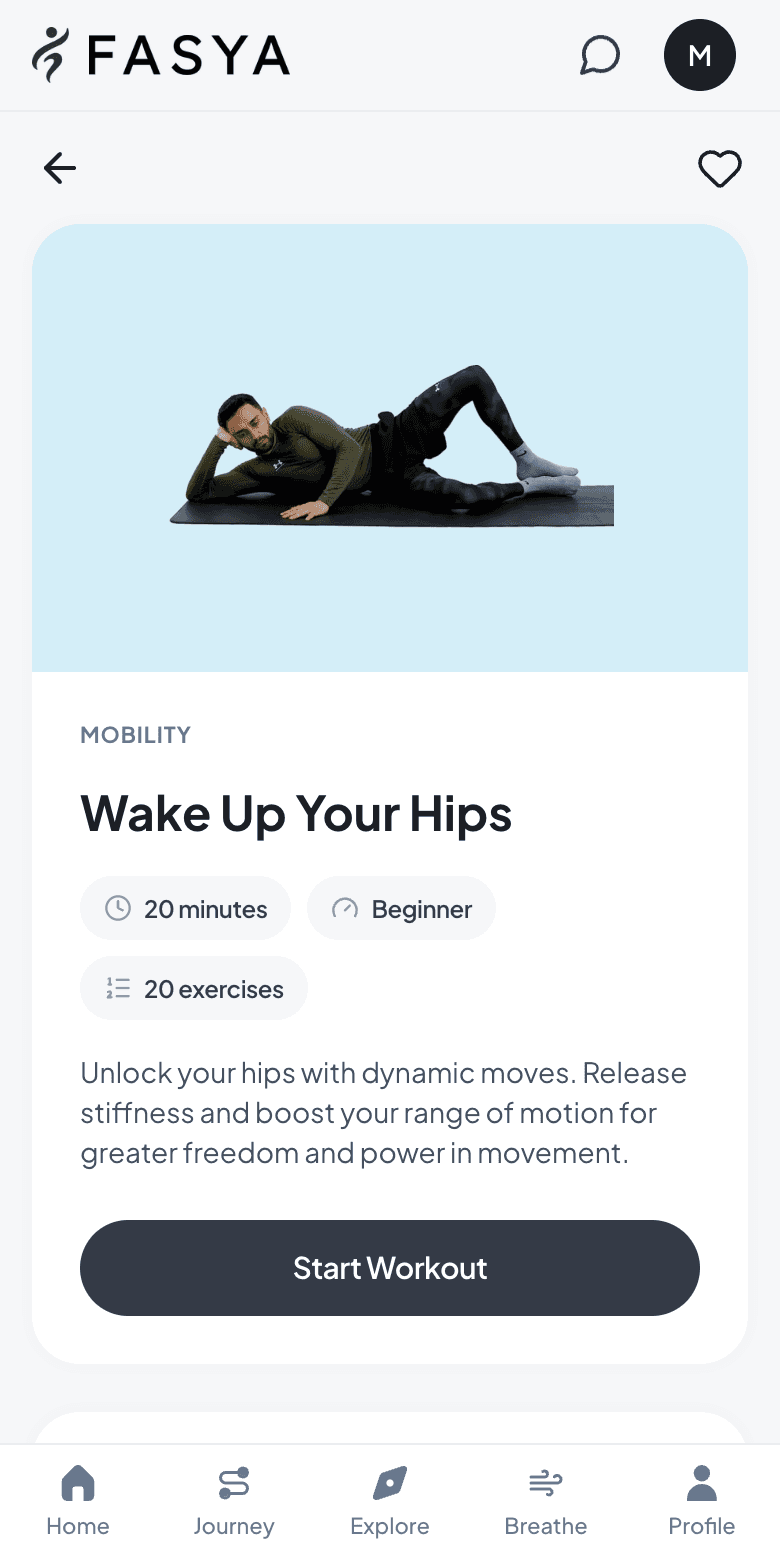
So rather than hunting for a single culprit, a broad movement programme that brings in the lower back's neighbours makes more sense. Fasya is a mobility app that builds you a route of workouts that follow on from each other, based on the region where you feel restricted; the routes are designed with this idea. If you want to work on your hips separately, take a look at the Wake Up Your Hips workout.
How to bring your hips into play with lower back pain
- Share the load when you bend. When you pick something up off the floor, do not just bend from your lower back; bend by pushing your hips back.
- Rotate your upper back. Sitting down, slowly turn left and right; try to make the turn come from your rib cage, not your lower back. The more your upper back rotates, the less work is left for your lower back.
- Reach diagonally. On all fours, reach one arm and the opposite leg out at the same time. A movement that uses the diagonal bridge in the lower back fascia.
- Try strengthening your hips. It has been shown to work for the knee. For the lower back the evidence is weak, but it is worth a try.
How many reps should you do? There is no exact number. A few slow reps several times a day is a good start. A little every day is easier to keep up than one long session a week.
Frequently asked questions
- Can tight hips cause lower back pain?
- It is possible, but not certain. The lower back and hips share the work when you bend forward, and a hip muscle and a back muscle meet in the same lower back fascia. Still, the evidence on the link between lower back pain and hip movement is of very low quality; working on your hips is worth trying, but the hips are not the only culprit.
- Can the place that hurts be different from where the problem is?
- Sometimes. When the rib cage does not rotate, the neck and lower back take more load. At the knee, strength work aimed at the hips reduces pain at the front of the knee, even though hip weakness is not the cause of the pain.
- Should I train my deep core muscles for lower back pain?
- Not necessarily. Programmes targeting specific deep muscles do not do better than general exercise. A broad movement programme you can keep up works at least as well.
Sources
Sources are taken from the expert-reviewed content cards in Fasya's knowledge base.
- Not merely a protective packing organ? A review of fascia and its force transmission capacity — Wilke J, Schleip R, Yucesoy CA, Banzer W, 2018
- The thoracolumbar fascia: anatomy, function and clinical considerations — Willard FH, Vleeming A, Schuenke MD, Danneels L, Schleip R, 2012
- Analysis of lumbar spine and hip motion during forward bending in subjects with and without a history of low back pain — Esola MA, McClure PW, Fitzgerald GK, Siegler S, 1996
- Is there an association between hip range of motion and nonspecific low back pain? A systematic review — Avman MA, Osmotherly PG, Snodgrass S, Rivett DA, 2019
- Is hip strength a risk factor for patellofemoral pain? A systematic review and meta-analysis — Rathleff MS, Rathleff CR, Crossley KM, Barton CJ, 2014
- Proximal muscle rehabilitation is effective for patellofemoral pain: a systematic review with meta-analysis — Lack S, Barton C, Sohan O, Crossley K, Morrissey D, 2015
- Hip-spine Syndrome — Devin CJ, McCullough KA, Morris BJ, Yates AJ, Kang JD, 2012
- Kinematics of the lumbar spine in trunk rotation: in vivo three-dimensional analysis using magnetic resonance imaging — Fujii R, Sakaura H, Mukai Y, et al., 2007
- An in vivo study of the primary and coupled rotations of the thoracic spine — Willems JM, Jull GA, Ng JK-F, 1996
- An update of stabilisation exercises for low back pain: a systematic review with meta-analysis — Smith BE, Littlewood C, May S, 2014
- Low back pain and sciatica in over 16s: assessment and management (NG59) — National Institute for Health and Care Excellence (NICE), 2020
- Red flags to screen for malignancy and fracture in patients with low back pain: systematic review — Downie A, Williams CM, Henschke N, et al., 2013
- Assessment and management of cauda equina syndrome — Greenhalgh S, Finucane L, Mercer C, Selfe J, 2018
- International Framework for Red Flags for Potential Serious Spinal Pathologies — Finucane LM, Downie A, Mercer C, et al., 2020
This article is for information only; it does not diagnose and is no substitute for an examination. If your symptoms persist, see a clinician.
Related articles
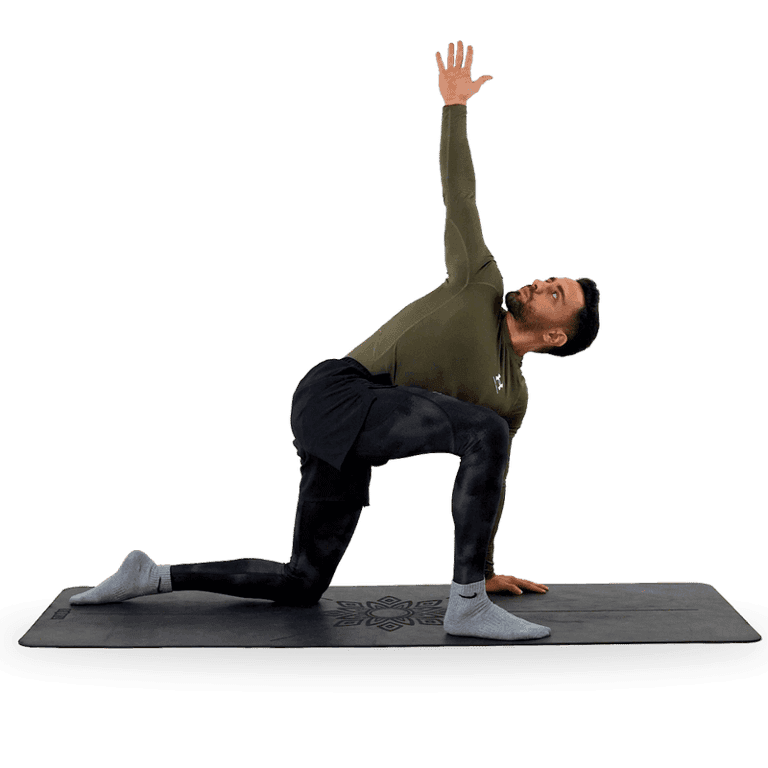
Reaching, bending, turning: why does the body move as one piece?
When you reach for a shelf or get up from a chair, your whole body is involved. How muscles connect through fascia, which myofascial lines really exist, and the simplest way to train everyday movements as a whole.
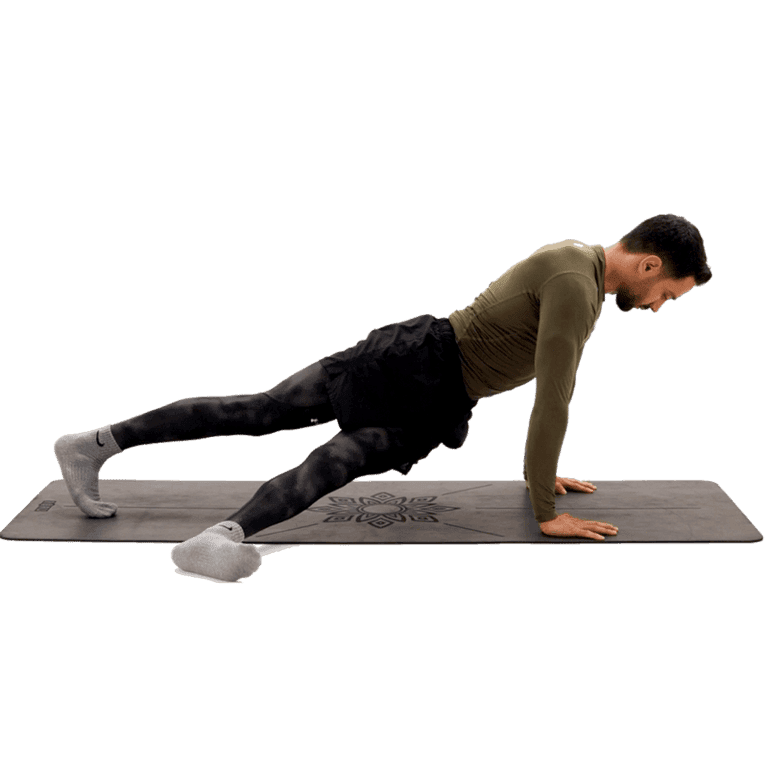
What helps lower back pain?
Lie down or keep moving? Which exercise? Do you need an MRI? What research says about lower back pain is simpler than you think, and practical enough to start today.
Why does my back hurt after sitting for a long time?
Is it the chair, your posture or a weak core? Research blames all three far less than you would think. What actually makes the difference, and what you can do at the same desk today.