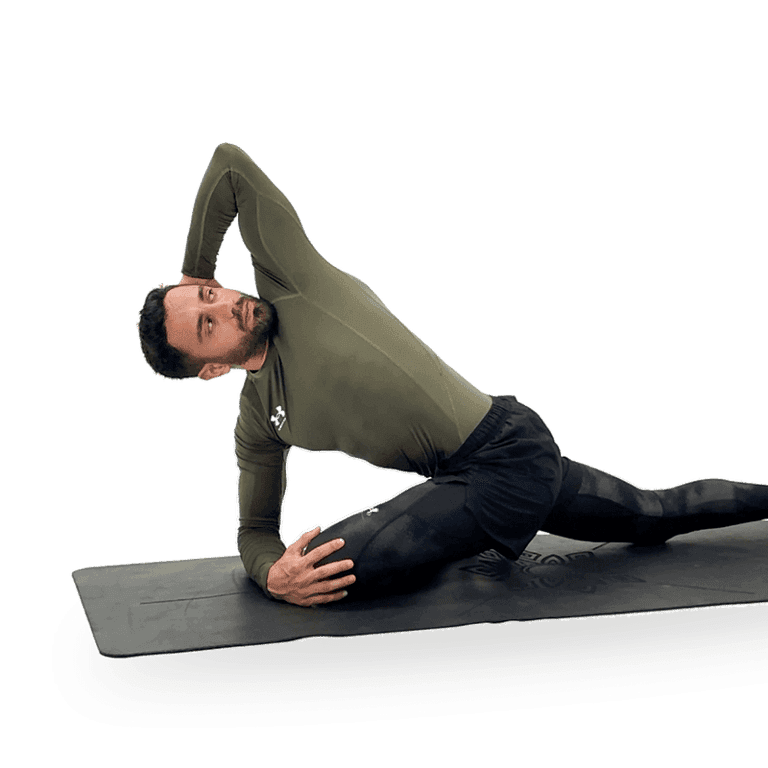
What is mobility? How is it different from flexibility?
Mobility is the range you control a joint through with your own strength. How it differs from flexibility, where stretching falls short, how to train it.
Sunday morning, you're on the mat. The person in the video lifts their leg up to their ear, you can't even fully straighten your knee, and the thought crosses your mind: "I'm just not flexible."
Mobility is the range through which you can move a joint with your own muscle strength and control. Flexibility is the furthest point that joint can reach with outside help, from gravity or from someone pushing. So the question mobility asks is not "how far do you open up" but "how much of that range do you actually own".
What's the difference between mobility and flexibility?
It comes down to one question: do you get to that range yourself, or does something put you there? Lying on your back, the point someone can push your leg to is your flexibility. The point you can lift the same leg to using only your own muscles, and hold it there for a few seconds, is your mobility.
Most people have a gap between those two points. The gap matters, because in a range you can't control, the body plays it safe and often answers by tensing up. Part of that familiar "pulling" feeling may come from here.
The same distinction applies to people at the other end. If your joints open wider than most people's, what you're missing isn't range but control within it. Reviews of exercise for these bodies point in a positive direction, but most of the studies are small and nobody has described a "best program". Some studies show that people with very loose joints have a weaker sense of where the joint is (proprioception).
An honest note: the word "mobility" has no scientific definition that everyone agrees on. It comes more from the working language of coaches and movement teachers, and some sources fold balance and coordination into it too. The "controlled range" definition we use here is the most common one. On the measurable side sits range of motion: the total path a joint can travel from one end to the other.
Does stretching improve mobility?
Partly. Stretching does something real: it increases range of motion, and most people find it feels good. But it doesn't do every job it gets credit for.
In a meta-analysis pooling randomised trials with more than 26,000 people, stretching had next to no effect on injury rates. In the same analysis, strength training cut injuries to roughly a third. Next-day muscle soreness tells a similar story: in a Cochrane review, the effect of stretching came to about one point on a 100-point scale.
There's one more thing. Most of the range you gain after stretching comes less from the muscle actually getting longer and more from a higher tolerance to the stretch; your nervous system starts treating that position as less of a threat. That isn't bad news. It just means the new range doesn't stay on its own.
To make it last, you need strength and control in that range. A meta-analysis comparing strength training with stretching found that the two gave similar results for increasing range. Slow, controlled lowering movements (eccentric training) also increase passive range in a measurable way.
Why does range of motion shrink over time?
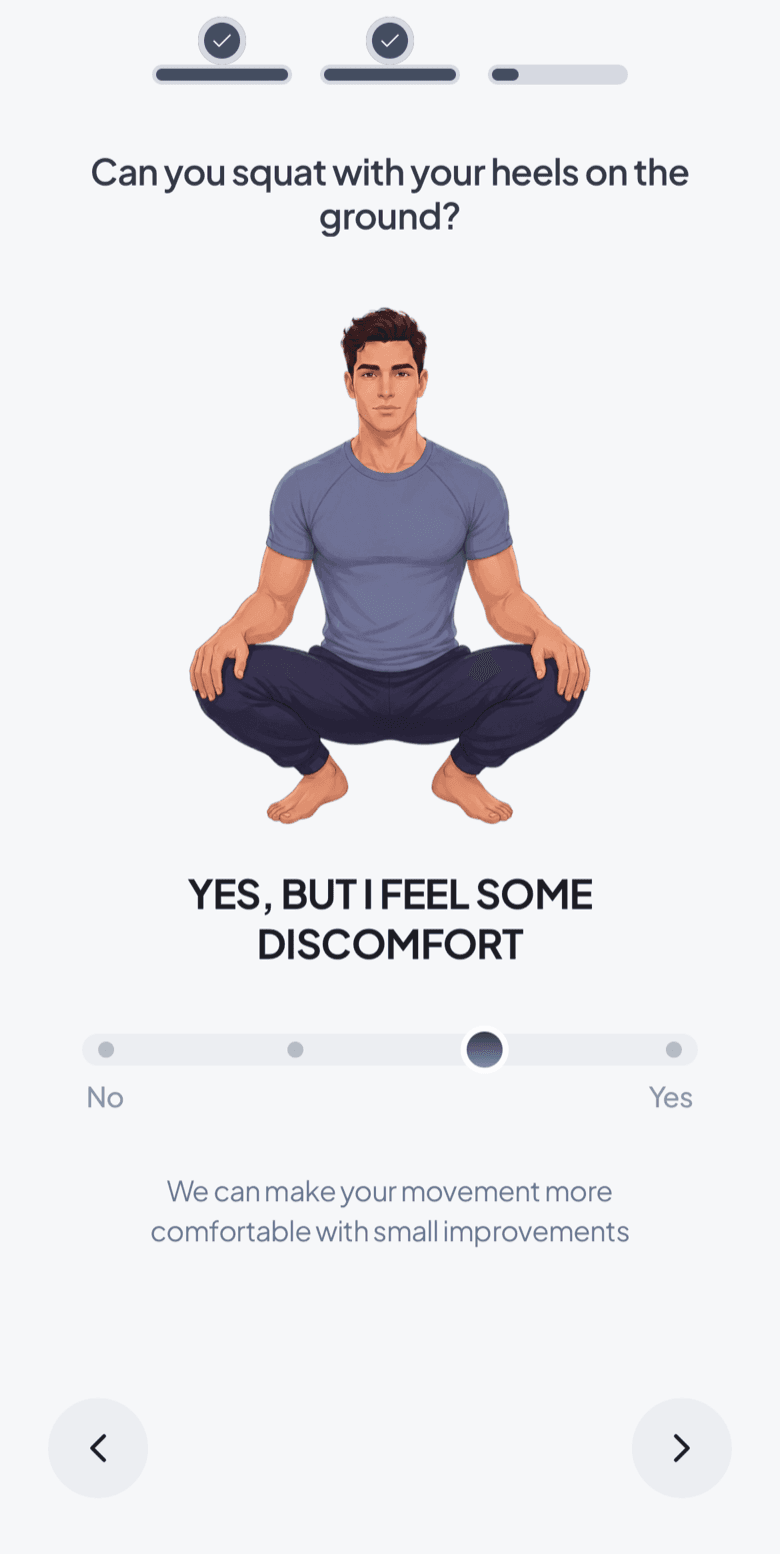
The body keeps what it uses. The parts of a joint's range you visit regularly stay where they are; the ends you never go to, the body may over time count as "not needed" and slowly narrow. Someone who has sat in chairs for years and never squats probably struggles to squat with their heels down for exactly this reason.
It makes sense to think this works the other way too: ends you visit regularly come back with time. But the pace isn't the same for everyone, and it's hard to give a clear picture of how it changes with age.
The real work starts with knowing where you're limited. The feeling that "everything is stiff" often comes down to one or two areas once you measure it, the hips for example. Fasya is a 5-minute-a-day mobility app, and the first step there is not a guess but a short check. How to actually stretch is covered in how should you stretch.
How do you train mobility?
You don't need an hour-long program for this. A few principles are enough:
- Get there under your own power. Take the movement only as far as your muscles alone can carry it, without pushing with your hand or against a wall, and hold for two or three seconds. The point where you lose control is the edge of your working range.
- Work just short of the edge. Instead of hanging at the very end, do slow reps in the part of the range right before it. If your joints already open very wide, this rule matters even more for you.
- Lower slowly. When you sink into a squat, bend forward or lower your arm, spread the movement over three or four seconds. It's the easiest form of eccentric training.
- Keep stretching, add one step after it. If stretching feels good, do it; then try reaching the same range under your own power.
- Little and often. A few minutes a day is far easier to keep up than one long session a week.
How long until you notice a difference in mobility?
Not every tissue changes at the same speed. The first change happens in the nervous system: coordination and comfort improve within days or weeks, and most of that "I've loosened up" feeling in the first weeks comes from there. For a measurable difference in tendon and connective tissue, studies usually put the lower limit at 8-12 weeks of regular loading.
We don't know for sure how much this varies from person to person. But if you don't see a big difference by week three, it doesn't mean you're doing something wrong. That's the timeline.
In practice it looks like this: pick one movement, say squatting with your heels on the floor. Go down a few times a day, stay two or three seconds near the bottom, come back up slowly. If your heels lift, put a folded towel under them. After a few weeks, try the same squat again and compare it with day one.
In short
Flexibility is where a joint can go. Mobility is being able to get there under your own power and stay there. Stretching increases range and feels good; what makes that range yours is building strength and control inside it. If you don't know where to start, measure first, then train a little, but regularly.
Frequently asked questions
- Are mobility and flexibility the same thing?
- No, but they're close relatives. Flexibility is the furthest point a joint can reach with outside help; mobility is the part of that range you can use with your own muscle strength and control.
- I'm not flexible. Can I still work on mobility?
- Yes, mobility work starts in the range you already have. A meta-analysis found that strength training gives similar results to stretching for increasing range, so stretching isn't the only way.
- Can I do mobility work every day?
- For most people, doing it every day is fine as long as you keep it short and gentle. A few minutes a day is easier to keep up than one long session a week.
- Does stretching prevent injuries?
- The evidence doesn't support that. In a meta-analysis covering more than 26,000 people, stretching had next to no effect on injury rates, while strength training cut injuries to roughly a third.
Sources
Sources are taken from the expert-reviewed content cards in Fasya's knowledge base.
- Strength Training versus Stretching for Improving Range of Motion: A Systematic Review and Meta-Analysis — Afonso J, Ramirez-Campillo R, Moscão J, et al., 2021
- Effects of Eccentric Resistance Training on Lower-Limb Passive Joint Range of Motion: A Systematic Review and Meta-analysis — Kay AD, Baxter BA, Hill MW, Blazevich AJ, 2022
- ACSM position stand: quantity and quality of exercise for developing and maintaining fitness in healthy adults — Garber CE, et al., 2011
- Becoming a Supple Leopard — Starrett K, 2013
- The effectiveness of exercise interventions to prevent sports injuries: a systematic review and meta-analysis of randomised controlled trials — Lauersen JB, Bertelsen DM, Andersen LB, 2014
- Stretching to prevent or reduce muscle soreness after exercise (Cochrane Review) — Herbert RD, de Noronha M, Kamper SJ, 2011
- Increasing muscle extensibility: a matter of increasing length or modifying sensation? — Weppler CH, Magnusson SP, 2010
- Human tendon adaptation in response to mechanical loading: a systematic review and meta-analysis of exercise intervention studies on healthy adults — Bohm S, Mersmann F, Arampatzis A, 2015
- Resistance training-induced changes in integrated myofibrillar protein synthesis are related to hypertrophy only after attenuation of muscle damage — Damas F, Phillips SM, Libardi CA, Vechin FC, Lixandrão ME, Jannig PR, et al., 2016
- The effectiveness of therapeutic exercise for joint hypermobility syndrome: a systematic review — Palmer S, Bailey S, Barker L, Barney L, Elliott A, 2014
- Do people with benign joint hypermobility syndrome (BJHS) have reduced joint proprioception? A systematic review and meta-analysis — Smith TO, Jerman E, Easton V, et al., 2013
- Hypermobility and the hypermobility syndrome — Simmonds JV, Keer RJ, 2007
- A framework for the classification of joint hypermobility and related conditions — Castori M, Tinkle B, Levy H, Grahame R, Malfait F, Hakim A, 2017
- The 2017 international classification of the Ehlers–Danlos syndromes — Malfait F, Francomano C, Byers P, et al., 2017
- Soft-tissue injuries simply need PEACE and LOVE — Dubois B, Esculier JF, 2020
This article is for information only; it does not diagnose and is no substitute for an examination. If your symptoms persist, see a clinician.