How to choose a mobility app: what to look for
What should you look for in a mobility app? Assessment, a sequenced program, a short daily dose and honest limits. A practical way to weigh app store promises.
Sunday evening, on the sofa, five pages deep in the app store. Every listing has the same photo: someone folding easily towards the floor and the words "a flexible body in 10 days". Which one actually works?
Short answer: a good mobility app measures you first, gives you movements in an order where each one supports the next rather than at random, stays sustainable with a dose of a few minutes a day, and tells you plainly what it cannot do. The rest is mostly packaging.
Is a mobility app the same as a stretching app?
No, and the difference changes your choice. The range someone else can push your leg into is flexibility. Being able to take that same leg there with your own muscles and hold it there is mobility. In a range you cannot control, the body plays it safe; it often answers by tensing up.
That is why a program made only of stretches falls short. A meta-analysis found strength training to be as effective as stretching at increasing range of motion. The idea that stretching protects against injury is weak too: in an analysis pooling randomised trials covering 26,000 people, stretching had next to no effect on injury rates, while strength training cut injuries to roughly a third.
What you need to check is simple. Does the app just keep you waiting in positions, or does it also train strength and control in the range you open up?
Which promises should you be sceptical of?
"The splits in seven days." "The program that ends your pain." Any sentence that gives a fixed date is a red flag. An app promising to end your pain belongs in the same group: movement helps many people with pain, but an app cannot diagnose and cannot promise treatment. Most of the range you gain quickly by stretching comes not from the muscle getting longer but from the nervous system treating the stretch as less of a threat. That is not a bad thing, but it shows that lasting change is slower.
Then there is variety. "A different routine every day" is an appealing promise. The research splits in two here: it is fairly solid that mixed practice makes a skill stick better and that variety supports sticking with exercise. The idea that "different loads give tissue different stimuli" is reasonable but has not been shown directly in humans. So variety is a good sign, but on its own it does not count as evidence.
Can an app give you a program without knowing you?
It can, but it is guessing. An app that does not measure offers everyone the same list; someone with a stiff neck and someone with tight hips get the same first day.
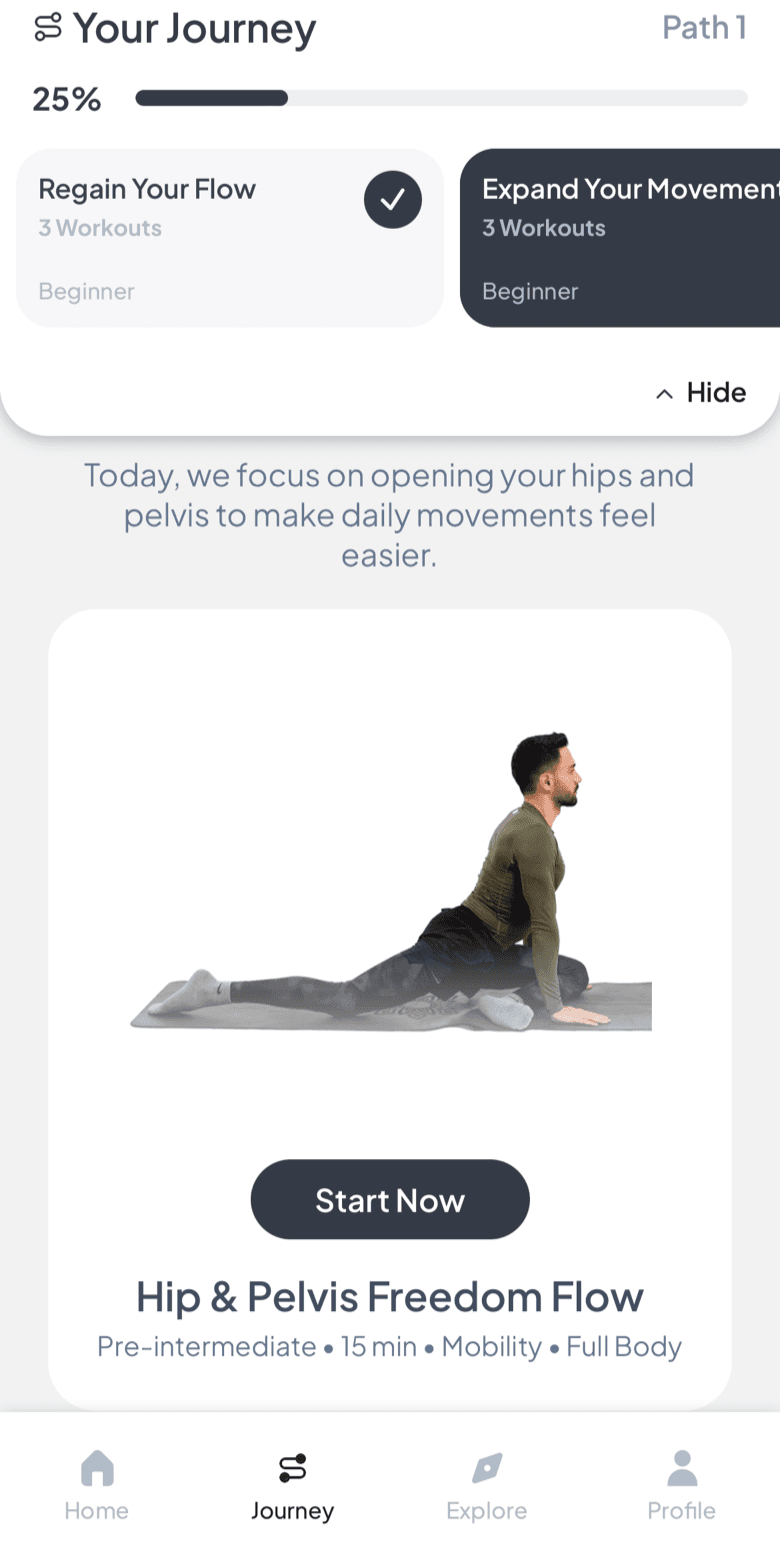
Fasya is a mobility app built around short daily movements; it starts with a movement assessment, and that assessment is free. It asks about your range of motion, your level and any areas of pain, then builds the routines around that. The honest limit: this is a self-assessment. It does not replace an examination and it does not diagnose. You can retake the test as things change. When you look at another app, ask the same question: does the result of the assessment actually change the program, or does everyone end up on the same list anyway?
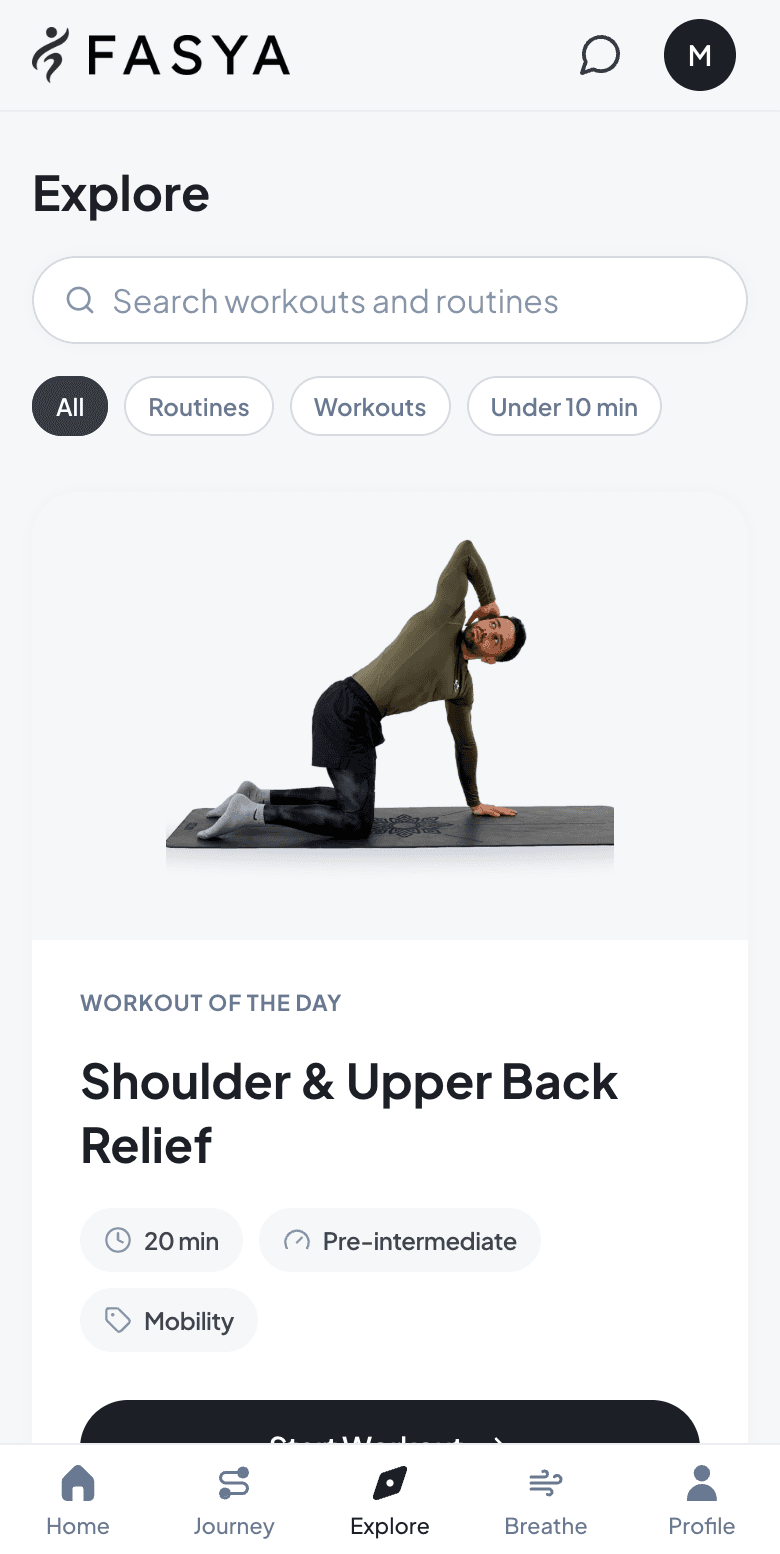
After assessment, the second question is order. Body regions do not work independently. Stiffness in the neck usually changes together with what the upper back and shoulders are doing, which is why a list that only stretches the neck can stop halfway. In Fasya, assessment is done with the free movement test, and workouts and routines on the Explore screen are sorted by length, level and type.
How many minutes a day is enough?
The World Health Organization's 2020 recommendation is 150 to 300 minutes of moderate activity a week, two days of strength training, and breaking up long periods of sitting. The same year the rule of "at least ten minutes at a time" was dropped; every bit of movement now counts. For stiffness and range of motion, though, there is no established minimum dose. We do not know it for sure.
What is known: the relief from a single session is short-lived. The drop in stiffness after stretching comes back within ten minutes, and the tissue's building response peaks at around 24 hours and fades over two to three days. The real advantage of small, frequent doses is that you can keep them up. A habit takes on average about two months to become automatic, and it varies from person to person between 18 and 250 days. Missing a single day does not break the process.
When will you notice a difference? The timing really does vary a lot between people; you are right to be wary of any source that gives you an exact day. The feeling of relief often comes in the first days; lasting change in range takes weeks. Taking a break is also not as costly as you think. When training stops, the adaptations you gained fade gradually over weeks; a one-week gap does not send you back to the start, it just pauses you. A good app does not punish you for a missed day, it makes it easy to pick up where you left off.
What should you check before downloading?
- Does it measure you on day one? Without assessment, the program is a guess.
- Are the movements in sequence? A random library and a route where each step feeds the next are not the same thing.
- Is the daily dose short? Without a five-to-ten-minute option, the chance you quit after the first intense week goes up.
- Is the free part actually usable? Use it for a few days without paying and see whether it works for you.
- Does it tell you its limits? Be wary of an app that never explains when to stop if something hurts.
When we ask ourselves the same questions, the honest picture is this: there is no free trial, and a subscription starts directly with the plan you choose. On the other hand, the movement test, the 5-minute Movement Task, Workout of the Day, Movement Snacks, Breathing Break and Fasya AI are free every day. All the workouts in your Personal Journey and some content unlock with Premium. So before you decide, you can spend a few days with the free part and see whether the daily habit sticks.
In short
A good mobility app starts by measuring you, gives you movements in order, keeps you going with short daily doses and does not hide its limits. Rule out the promises that give a fixed date, try the free part for a few days, and most of the choice makes itself.
Frequently asked questions
- Do mobility apps actually work?
- They can if you use them regularly, but what does the work is the regularity, not the app. An app that starts with an assessment, puts movements in order and offers a short daily dose makes the habit easier to keep.
- How many minutes of mobility work a day is enough?
- There is no established minimum dose for range of motion. The practical answer is the amount you can repeat every day: for most people five to ten minutes is more sustainable than one long weekly session.
- What's the difference between stretching and mobility?
- Flexibility is the range someone else can take you into; mobility is being able to get into that range with your own muscles and stay there. That is why a good program trains control and strength alongside stretches.
- Is a free mobility app enough?
- Often enough to get started. If the free part can be used every day, first see whether the habit sticks; if you need a personalised route, decide on a paid plan later.
Sources
Sources are taken from the expert-reviewed content cards in Fasya's knowledge base.
- Strength Training versus Stretching for Improving Range of Motion: A Systematic Review and Meta-Analysis — Afonso J, Ramirez-Campillo R, Moscão J, et al., 2021
- The effectiveness of exercise interventions to prevent sports injuries: a systematic review and meta-analysis of randomised controlled trials — Lauersen JB, Bertelsen DM, Andersen LB, 2014
- Increasing muscle extensibility: a matter of increasing length or modifying sensation? — Weppler CH, Magnusson SP, 2010
- Contextual interference effects on the acquisition, retention, and transfer of a motor skill — Shea JB, Morgan RL, 1979
- Variety support and exercise adherence behavior: experimental and mediating effects — Sylvester BD, Standage M, Dowd AJ, Martin LJ, Sweet SN, Beauchamp MR, 2015
- Is movement variability important for sports biomechanists? — Bartlett R, Wheat J, Robins M, 2007
- World Health Organization 2020 guidelines on physical activity and sedentary behaviour — Bull FC, Al-Ansari SS, Biddle S, et al., 2020
- Chronic effects of stretching on range of motion with consideration of potential moderating variables: a systematic review with meta-analysis — Konrad A, Alizadeh S, Daneshjoo A, et al., 2024
- Decrements in stiffness are restored within 10 min — Mizuno T, Matsumoto M, Umemura Y, 2013
- Coordinated collagen and muscle protein synthesis in human patella tendon and quadriceps muscle after exercise — Miller BF, Olesen JL, Hansen M, et al., 2005
- Effect of number of home exercises on compliance and performance in adults over 65 years of age — Henry KD, Rosemond C, Eckert LB, 1999
- How are habits formed: Modelling habit formation in the real world — Lally P, van Jaarsveld CHM, Potts HWW, Wardle J, 2009
- Detraining: Loss of Training-Induced Physiological and Performance Adaptations. Part I — Mujika I, Padilla S, 2000
- The clinical course of acute, subacute and persistent low back pain: a systematic review and meta-analysis — Wallwork SB, Braithwaite FA, O'Keeffe M, et al., 2024
- 2018 ESC Guidelines for the diagnosis and management of syncope — Brignole M, Moya A, de Lange FJ, et al., 2018
- Updating ACSM's Recommendations for Exercise Preparticipation Health Screening — Riebe D, Franklin BA, Thompson PD, et al., 2015
- Prevalence of and screening for serious spinal pathology in patients presenting to primary care settings with acute low back pain — Henschke N, Maher CG, Refshauge KM, et al., 2009
- International Framework for Red Flags for Potential Serious Spinal Pathologies — Finucane LM, Downie A, Mercer C, et al., 2020
This article is for information only; it does not diagnose and is no substitute for an examination. If your symptoms persist, see a clinician.