
The stiffness that comes with age: how much is age, how much is inactivity?
Does flexibility decrease with age? What really changes in connective tissue, how much stiffness comes from not moving, and how to load tissue at any age.
At twenty-five, sitting down on the floor and getting back up was nothing; you went down without thinking and came up without thinking. At forty-five the same movement comes with a small "oof".
The short answer: yes, connective tissue really does change with age; it gets a little stiffer, it has a harder time springing back after being stretched, and it repairs more slowly. But a large part of everyday stiffness is not age, it is movement that has become less frequent and more monotonous. Tissue adapts to whatever load it sees, and that ability does not disappear with age.
Why does flexibility decrease with age?
Connective tissue is the general name for the tissue that wraps your muscles, tendons and joints and links them together. It contains collagen fibres that resist pulling, elastin fibres that let it stretch and spring back, and a watery ground substance that fills the gaps between them. Over the years all three change. Extra cross-links build up between collagen fibres and the tissue stiffens. Elastin decreases, so stretched tissue no longer springs back as easily. The ground substance holds less water, and the cells that repair the tissue work more slowly.
Some of these cross-links form when sugar sticks to collagen (glycation), and they seem to be permanent. Blood sugar that stays high for a long time is thought to speed up this process; how much it speeds it up, we do not know.
For women there is one more threshold. During the menopause transition, as oestrogen falls, bone loss speeds up, and muscle mass and strength also tend to decline in the same years. Oestrogen is known to affect collagen turnover in tendons and connective tissue; whether it is behind the joint pain of this period is not yet clear.
Why do we get stiff as we get older?
The changes above are real, but slow, and they do not happen at the same speed for everyone. The stiffness you feel has another source: movement you no longer use.
The principle called tissue adaptation is simple: muscle, tendon, bone and connective tissue slowly reshape themselves according to the load you regularly give them. Your body becomes suited to whatever you do. At twenty-five you sat on the floor, ran, carried things, turned at all sorts of angles. If at forty-five your day is spent between a chair, a car and a sofa, the message the tissue gets changes too: these angles are no longer needed. Capacity that is not used gets pulled back; capacity that is used is kept.
Morning stiffness shows this well. At night you barely move for hours; your discs draw in water, your tissues cool down, and muscle and connective tissue get temporarily heavier when they stay still. Normally it eases within the first ten to thirty minutes as you move. If it eases, the tissue is not damaged; it has simply been still all night.
Separating the share of age from the share of inactivity, person by person, is not possible today. But the second one is the side you can change.
Does using your joints wear them out?
This is the most common fear: "I am getting older, I should go easy on my joints." The data say something else. In a meta-analysis covering 125,000 people, hip and knee osteoarthritis was 3.5 percent in recreational runners, 10.2 percent in people who lived sedentary lives and 13.3 percent in people who competed at high volume for years. This is not proof of cause and effect, but the risk does not sit in the middle; it shows up at the two extremes. Cartilage responds to load too: in a randomised study of people at high risk of osteoarthritis, four months of moderate exercise increased the content of a substance that reflects how well cartilage carries load. We cover the running side separately in the article on running and knees.
Bone shows a similar picture. In the LIFTMOR study, postmenopausal women with low bone density took part in a programme of thirty-minute sessions of heavy resistance and impact training twice a week; in a supervised setting, their bone density and physical function increased safely.
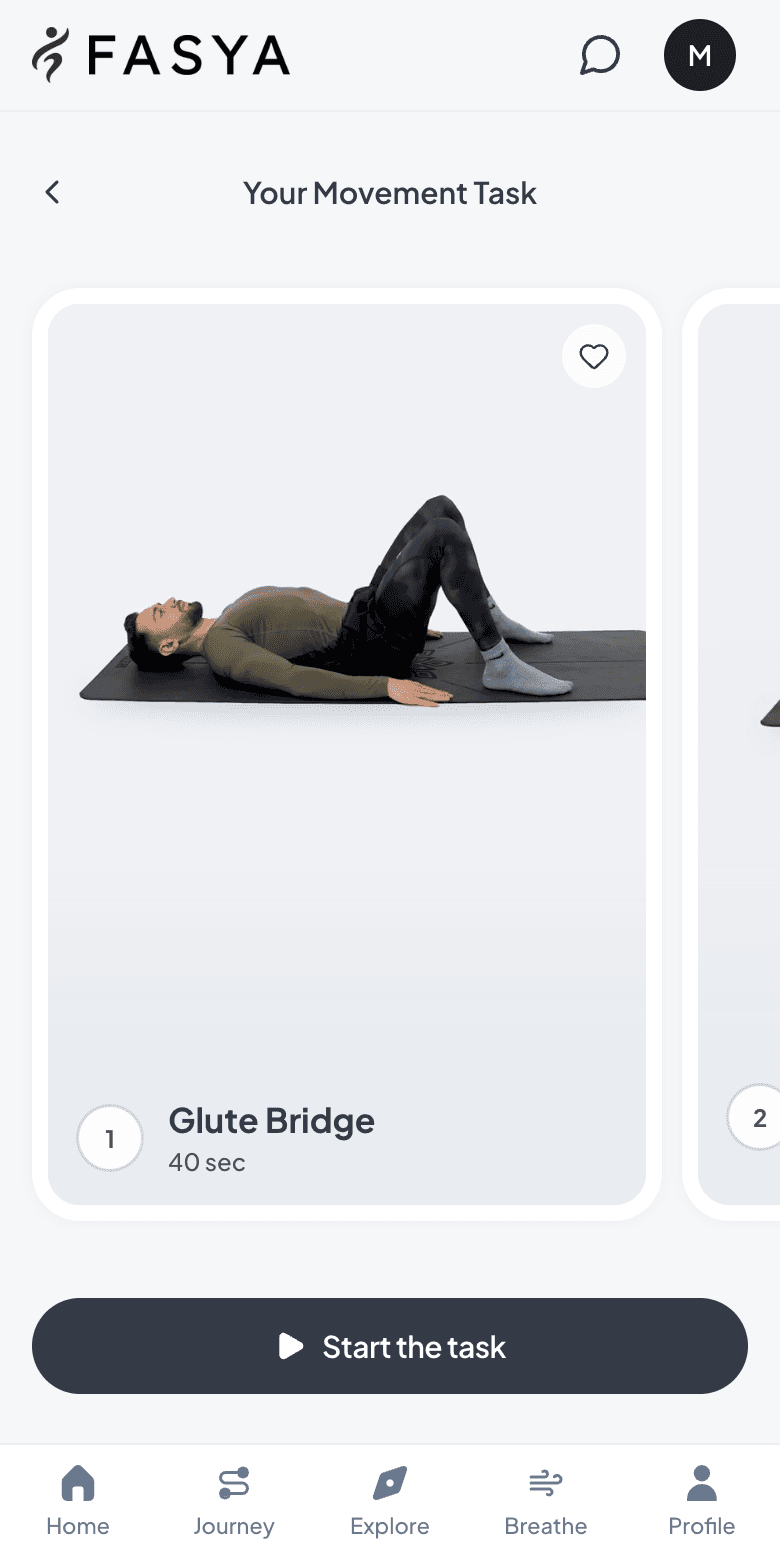
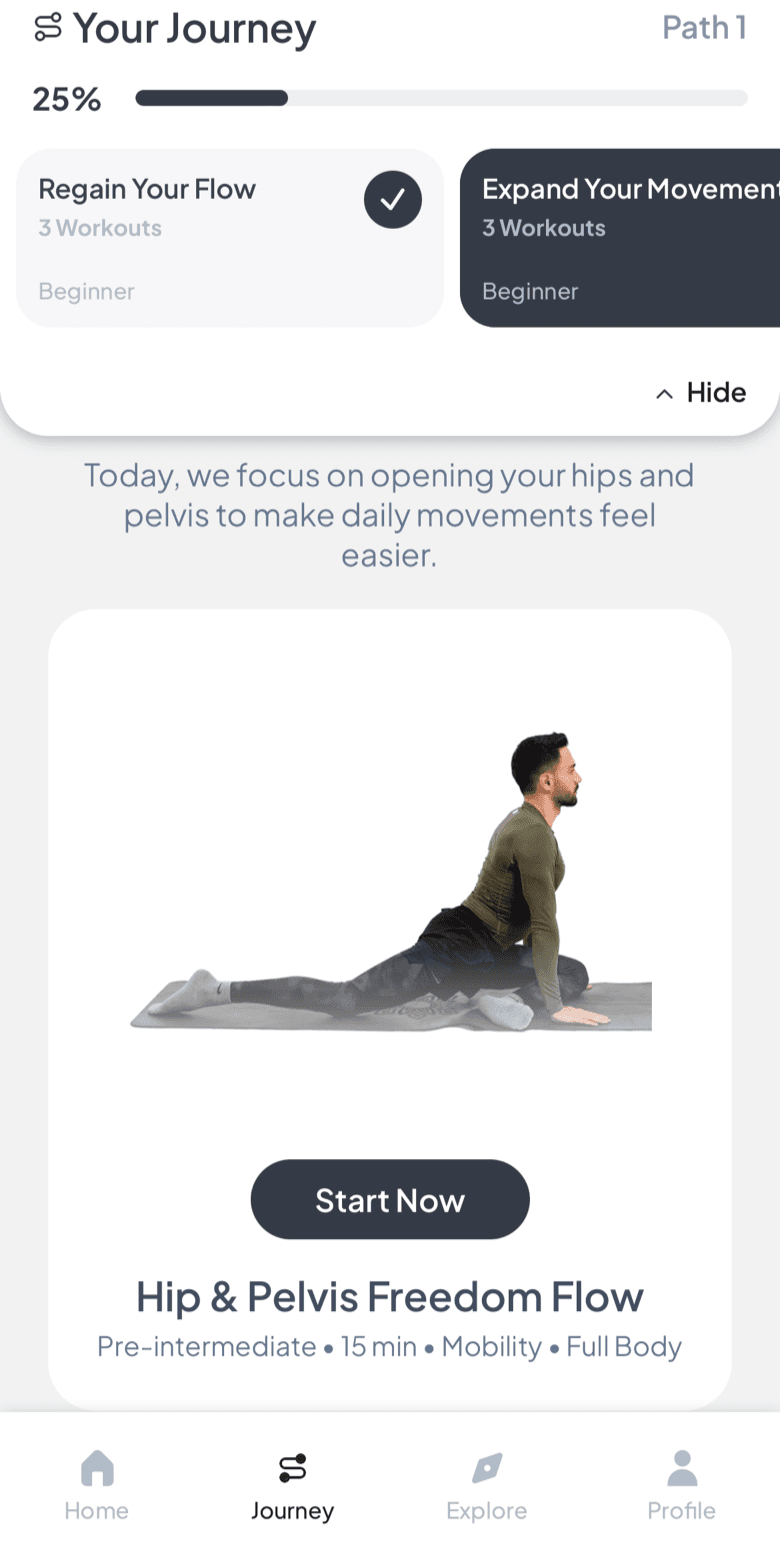
What changes with age is not whether tissue responds to load, but how quickly it responds and at what dose. That is why it matters that load increases in order and a little at a time, not at random. Fasya is a mobility app built on short sessions, and the personal route inside it is built on the same logic. For anyone who wants just one small step a day, there is also a daily task, Your Movement Task.
How do you keep your flexibility after 40?
The principle does not change with age; the settings do:
- Start from what you can comfortably handle today. Progressive loading means starting a movement at the dose your body can handle today and increasing it a little at a time. It is the best-known way to help both the tissue and a cautious nervous system get used to load.
- Train strength and range of motion together. Stretching opens up the angle; strength teaches you to carry load at that angle. Getting down to the floor and back up asks for both at once.
- Do the same movement in different ways. Different heights, speeds, surfaces. Mixed practice has been shown to make a skill stick better, and variety makes it easier to keep going. The idea that different loads give the tissue a separate stimulus makes sense, but it has not yet been proven in studies on people.
- Choose regularity over intensity. The World Health Organization recommends strength training two days a week for adults. There is no established minimum dose for flexibility; what is enough for you is the amount you can keep repeating.
How long until you notice a difference?
There are two separate processes here. Feeling looser after a session is real, but most of it is neural: your pain threshold rises and your tolerance for the same stretch goes up. These effects arrive within minutes and fade just as fast. Change in the tissue itself is slow: measurable change in tendon usually takes eight to twelve weeks of regular loading, and the collagen in some tissues hardly renews at all in adulthood. At forty-five this process still works; maybe a little more slowly, but it works.
Keep your own measure simple: notice how many minutes it takes for your morning stiffness to ease, and how much you need your hands to get down to the floor and back up. If these two change over the weeks, you are on the right track.
In short
Connective tissue really does change with age, and you cannot turn that back. But part of the stiffness you feel comes from movement you no longer use, and that side is still in your hands. Tissue adapts in the direction of the load it sees; increasing load a little at a time and repeating it regularly is the most solid known way to keep that capacity at any age.
Frequently asked questions
- Does flexibility decrease with age?
- To some extent, yes. With age, connective tissue stiffens, partly loses its ability to stretch and spring back, and repairs more slowly. But a large part of everyday stiffness comes from movement that has become less frequent and more monotonous; tissue keeps adapting to regular load at any age.
- Can you gain flexibility after 40?
- You can, but it takes patience. The relief in the first weeks mostly comes from the nervous system's tolerance; for measurable change in tissues like tendon, it usually takes eight to twelve weeks of regular loading.
- I am getting older. Is lifting weights harmful?
- Usually not, when it is increased gradually. In the LIFTMOR study, postmenopausal women with low bone density increased their bone density and function with a supervised programme of heavy resistance and impact training. If you have diagnosed osteoporosis, a history of fractures or a spinal condition, plan the programme with your doctor.
- Is waking up stiff in the morning a sign of aging?
- Most of the time, no; it is the result of not moving all night. Your discs draw in water and your tissues cool down and get heavier; normally it eases with movement within ten to thirty minutes. Stiffness that lasts more than an hour, gets worse with rest or comes with swelling should be checked by a doctor.
Sources
Sources are taken from the expert-reviewed content cards in Fasya's knowledge base.
- Mechanotherapy: how physical therapists' prescription of exercise promotes tissue repair — Khan KM, Scott A, 2009
- Graded activity and graded exposure for persistent nonspecific low back pain: a systematic review — Macedo LG, Smeets RJEM, Maher CG, Latimer J, McAuley JH, 2010
- Human tendon adaptation in response to mechanical loading: a systematic review and meta-analysis of exercise intervention studies on healthy adults — Bohm S, Mersmann F, Arampatzis A, 2015
- Resistance training-induced changes in integrated myofibrillar protein synthesis are related to hypertrophy only after attenuation of muscle damage — Damas F, Phillips SM, Libardi CA, Vechin FC, Lixandrão ME, Jannig PR, et al., 2016
- Radiocarbon dating reveals minimal collagen turnover in both healthy and osteoarthritic human cartilage — Heinemeier KM, Schjerling P, Heinemeier J, Møller MB, Krogsgaard MR, Grum-Schwensen T, et al., 2016
- A meta-analytic review of the hypoalgesic effects of exercise — Naugle KM, Fillingim RB, Riley JL, 2012
- Increasing muscle extensibility: a matter of increasing length or modifying sensation? — Weppler CH, Magnusson SP, 2010
- Lack of tissue renewal in human adult Achilles tendon is revealed by nuclear bomb 14C — Heinemeier KM, Schjerling P, Heinemeier J, Magnusson SP, Kjaer M, 2013
- Contextual interference effects on the acquisition, retention, and transfer of a motor skill — Shea JB, Morgan RL, 1979
- Variety support and exercise adherence behavior: experimental and mediating effects — Sylvester BD, Standage M, Dowd AJ, Martin LJ, Sweet SN, Beauchamp MR, 2015
- Is movement variability important for sports biomechanists? — Bartlett R, Wheat J, Robins M, 2007
- World Health Organization 2020 guidelines on physical activity and sedentary behaviour — Bull FC, Al-Ansari SS, Biddle S, et al., 2020
- Chronic effects of stretching on range of motion with consideration of potential moderating variables: a systematic review with meta-analysis — Konrad A, Alizadeh S, Daneshjoo A, et al., 2024
- The association of recreational and competitive running with hip and knee osteoarthritis: a systematic review and meta-analysis — Alentorn-Geli E, Samuelsson K, Musahl V, Green CL, Bhandari M, Karlsson J, 2017
- Positive effects of moderate exercise on glycosaminoglycan content in knee cartilage: a four-month randomized controlled trial in patients at risk of osteoarthritis — Roos EM, Dahlberg L, 2005
- Management of osteoporosis in postmenopausal women: the 2021 position statement of The North American Menopause Society — The North American Menopause Society, 2021
- High-Intensity Resistance and Impact Training Improves Bone Mineral Density and Physical Function in Postmenopausal Women With Osteopenia and Osteoporosis: The LIFTMOR Randomized Controlled Trial — Watson SL, Weeks BK, Weis LJ, Harding AT, Horan SA, Beck BR, 2018
- Influence of sex and estrogen on musculotendinous protein turnover at rest and after exercise — Hansen M, Kjaer M, 2014
- The musculoskeletal syndrome of menopause — Wright VJ, Schwartzman JD, Itinoche R, Wittstein J, 2024
- In vivo diurnal variation in intervertebral disc volume and morphology — Botsford DJ, Esses SI, Ogilvie-Harris DJ, 1994
- Thixotropy in skeletal muscle and in muscle spindles: a review — Proske U, Morgan DL, Gregory JE, 1993
- New criteria for inflammatory back pain in patients with chronic back pain: a real patient exercise by experts from ASAS — Sieper J, van der Heijde D, Landewé R, et al., 2009
- Inflammatory back pain in ankylosing spondylitis: a reassessment of the clinical history — Rudwaleit M, Metzger AK, Sieper J, Braun J, 2006
This article is for information only; it does not diagnose and is no substitute for an examination. If your symptoms persist, see a clinician.
Related articles
Is running and jumping bad for your knees?
"Keep running and you'll wreck your knees" isn't backed by the data. What a meta-analysis of 125,000 people found, how cartilage and tendon adapt to load, and how to carry on when your knee hurts.
Why do we wake up stiff in the morning?
Your lower back says "slow down" as you get out of bed; ten minutes later everything has settled. What happens in the body overnight, why stiffness eases with movement, and in which rare case it really is a sign.
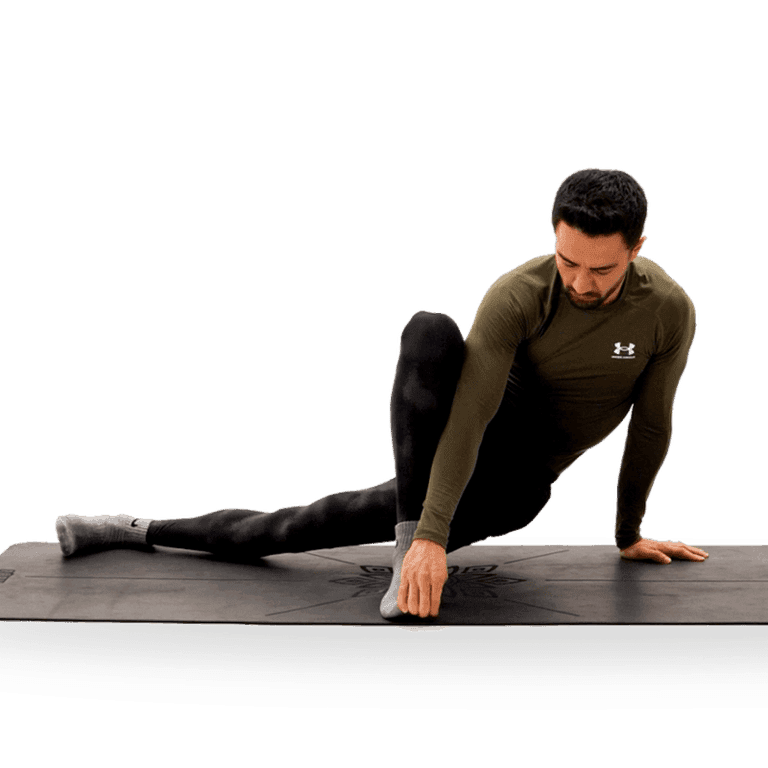
How should you stretch?
There's no one number of seconds to hold a stretch that fits everyone. Why does a stretch get easier the longer you hold it, do muscles actually lengthen, and what should you look at instead of seconds for lasting flexibility?