
Is running and jumping bad for your knees?
Is running bad for your knees? What a meta-analysis of 125,000 people found, how cartilage and tendon adapt to load, and how to keep going when your knee hurts.
You want to turn your morning walk into an easy jog. A familiar voice in your head: "You'll ruin your knees." On the stairs, a kid bounces down the steps; you're holding the handrail.
Short answer: people who run recreationally get knee and hip osteoarthritis less often than people who don't move much. The risk isn't in the middle, it sits at the two ends: those who don't move at all and those who race at very high volume for years. Cartilage and tendon both respond to load. The question isn't whether you run, it's how much and how.
Do runners wear out their knees faster?
The data point the other way. In a meta-analysis covering 125,000 people, hip and knee osteoarthritis showed up in 3.5 percent of recreational runners, 10.2 percent of sedentary people and 13.3 percent of those who raced at high volume for years. That's not proof of cause and effect, but it doesn't support "running wears down your knees" either.
Cartilage responds to load too. In a randomised trial with people at high risk of osteoarthritis, four months of moderate exercise increased the content of a substance that reflects the cartilage's load-bearing quality. A joint isn't a part you protect by using it sparingly; it's a tissue that adapts as you use it. We covered the stiffness that comes with age in a separate post.
How do tendons adapt to load?
When you walk, your heel lands, your weight shifts forward and the Achilles tendon at the back of your calf stretches like a rubber band. As you push off through your toes, that tension is released. Your calf muscle doesn't do all the work alone; the tendon stores part of the energy and gives it back. Running and jumping run the same cycle, faster and harder.
A measurable change in a tendon usually takes 8 to 12 weeks of regular loading. The reverse holds too: rest removes the stimulus, and over the same time the tendon's capacity to carry load drops. Maybe that's part of why the hand reaches for the rail. The less you bounce, the more foreign bouncing feels.
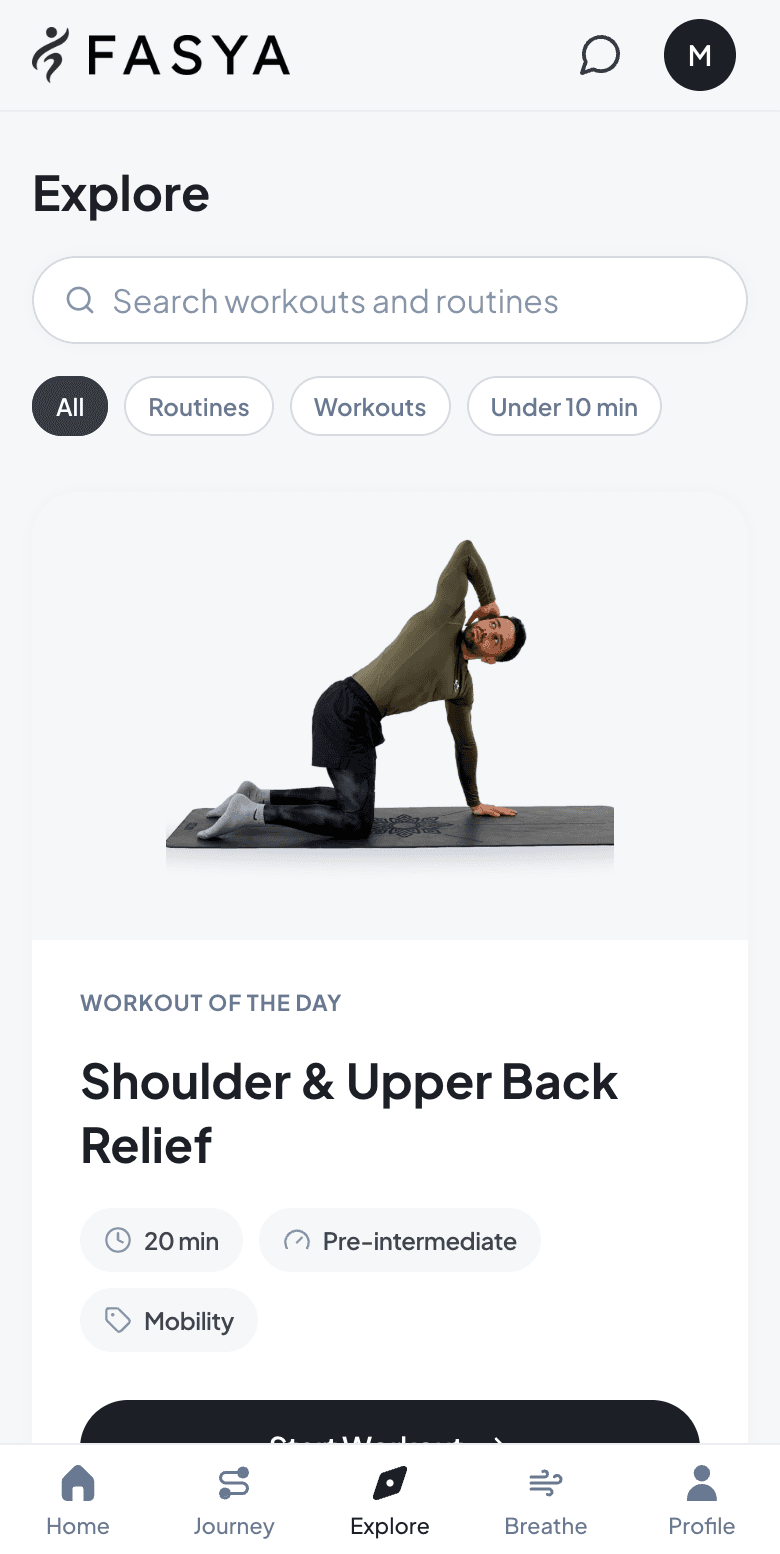
Fasya is a mobility app that suggests one free session every day; the Workout of the Day is built from short, regular movements that change daily.
How do you start running and jumping?
The goal isn't to jump high but to get a small, rhythmic bounce. On a pain-free day, after warming up:
- Heel bounce. Rise onto your toes, let your heels drop lightly without touching the floor and spring back up with a small bounce.
- Skipping rhythm. No rope, on the spot, low and steady bounces on the balls of your feet.
- Add short runs to your walk. While walking briskly, slip in a few short, easy runs.
Land soft and quiet; if you're hitting the ground hard, reduce the height or the speed. Over the weeks, build the time up bit by bit; that's called gradual loading.
Can I keep going when my knee or tendon hurts?
Most of the time, adjusting the amount works better than stopping completely. If the pain is in a tendon, the rule is clear: pain up to 5 out of 10 during and after exercise is considered acceptable. The real test is the next morning. If you get up feeling much like the day before, the amount is right; if it's clearly worse, don't quit, cut the amount.
Frequently asked questions
- Is running bad for your knees?
- For recreational runners, generally not. In a meta-analysis of 125,000 people, osteoarthritis showed up in 3.5 percent of recreational runners, 10.2 percent of sedentary people and 13.3 percent of those who raced at high volume for years. It's not proof of cause and effect, but the risk seems to sit at the two ends.
- Is jumping bad for your knees?
- Small, rhythmic jumping that you build up gradually usually isn't. Tendons get stronger when they're loaded regularly. Land softly; if your pain is worse the next morning, cut the amount.
- Should I stop running if my knee hurts?
- Most of the time, adjusting the amount works better than stopping completely. If your knee swells, locks or the pain lasts for days, reduce the load; if the pain keeps going, set up a program with a physiotherapist.
- Is fascial fitness backed by science?
- Partly. It's well known that tendons adapt to regular load and get stronger. Fascial fitness is a training approach that combines this with jumping, moving in different directions and slow stretching; the approach itself hasn't been tested separately. Claims like "jumping makes your fascia more elastic" haven't been proven in studies on people yet either.
Sources
Sources are taken from the expert-reviewed content cards in Fasya's knowledge base.
- The association of recreational and competitive running with hip and knee osteoarthritis: a systematic review and meta-analysis — Alentorn-Geli E, Samuelsson K, Musahl V, Green CL, Bhandari M, Karlsson J, 2017
- Positive effects of moderate exercise on glycosaminoglycan content in knee cartilage: a four-month randomized controlled trial in patients at risk of osteoarthritis — Roos EM, Dahlberg L, 2005
- Human tendon adaptation in response to mechanical loading: a systematic review and meta-analysis of exercise intervention studies on healthy adults — Bohm S, Mersmann F, Arampatzis A, 2015
- ICON 2019: International Scientific Tendinopathy Symposium Consensus: Clinical Terminology — Scott A, Squier K, Alfredson H, et al., 2020
- Is tendon pathology a continuum? A pathology model to explain the clinical presentation of load-induced tendinopathy — Cook JL, Purdam CR, 2009
- Achilles and Patellar Tendinopathy Loading Programmes: A Systematic Review Comparing Clinical Outcomes and Identifying Potential Mechanisms for Effectiveness — Malliaras P, Barton CJ, Reeves ND, Langberg H, 2013
- Continued Sports Activity, Using a Pain-Monitoring Model, during Rehabilitation in Patients with Achilles Tendinopathy: A Randomized Controlled Study — Silbernagel KG, Thomeé R, Eriksson BI, Karlsson J, 2007
- Heavy Slow Resistance Versus Eccentric Training as Treatment for Achilles Tendinopathy: A Randomized Controlled Trial — Beyer R, Kongsgaard M, Hougs Kjær B, Øhlenschlæger T, Kjær M, Magnusson SP, 2015
- Graded activity and graded exposure for persistent nonspecific low back pain: a systematic review — Macedo LG, Smeets RJEM, Maher CG, Latimer J, McAuley JH, 2010
This article is for information only; it does not diagnose and is no substitute for an examination. If your symptoms persist, see a clinician.
Related articles
The stiffness that comes with age: how much is age, how much is inactivity?
At twenty-five you sat down on the floor and got up without a thought; at forty-five an "oof" came along with it. Some things really do change in connective tissue with age, but part of the stiffness you feel is not age, it is movement you no longer use.
Why does my heel hurt with the first steps in the morning?
A sharp pain on the first step, almost nothing a few minutes later. Why morning heel pain behaves like this, how much a heel spur really matters and what you can try today.