Why does my heel hurt with the first steps in the morning?
Heel stabbing when you get out of bed? Morning heel pain is rarely a tear but tissue getting used to load. Why it happens, what helps, when to see a doctor.
Six thirty in the morning. You switch off the alarm, put your foot on the floor and a knife-like pain shoots through the inner edge of your heel. You limp to the kitchen. By the time the coffee is ready, the pain is almost gone. In the evening, getting up after a long meeting, there it is again.
Heel pain with the first steps in the morning usually doesn't mean something has torn. The tissue under your foot has had no load all night, then suddenly takes your full weight on the first step, and it needs a few steps to adjust. That pattern is almost the signature of plantar heel pain, and it's common. It generally settles with gradual loading and patience. The patience part matters: think months, not weeks.
Why is heel pain worse in the morning?
All night your foot carries no load at all. The tissue in your sole comes out of that quiet and has to handle your whole body weight on the first step. It adapts within a few steps and the pain eases. That's also why the same sting comes back when you stand up after sitting for a long time. If it builds toward the evening after a day on your feet, that has to do with total load.
This is different from the morning stiffness where your whole body wakes up slowly. Here the issue is one tissue going back under load.
Plantar fasciitis or heel spur?
The name is a bit misleading. "Fasciitis" means inflammation, yet in the tissue that has been studied the main finding isn't classic inflammation but a breakdown in how the collagen is organised. That's why the field increasingly says "plantar heel pain" instead.
If an X-ray showed a heel spur, there's no need to panic. A study that followed 174 people for 5 to 15 years found that a heel spur did not predict recovery. Why a spur comes with pain in some feet and sits quietly in others, we honestly don't know.
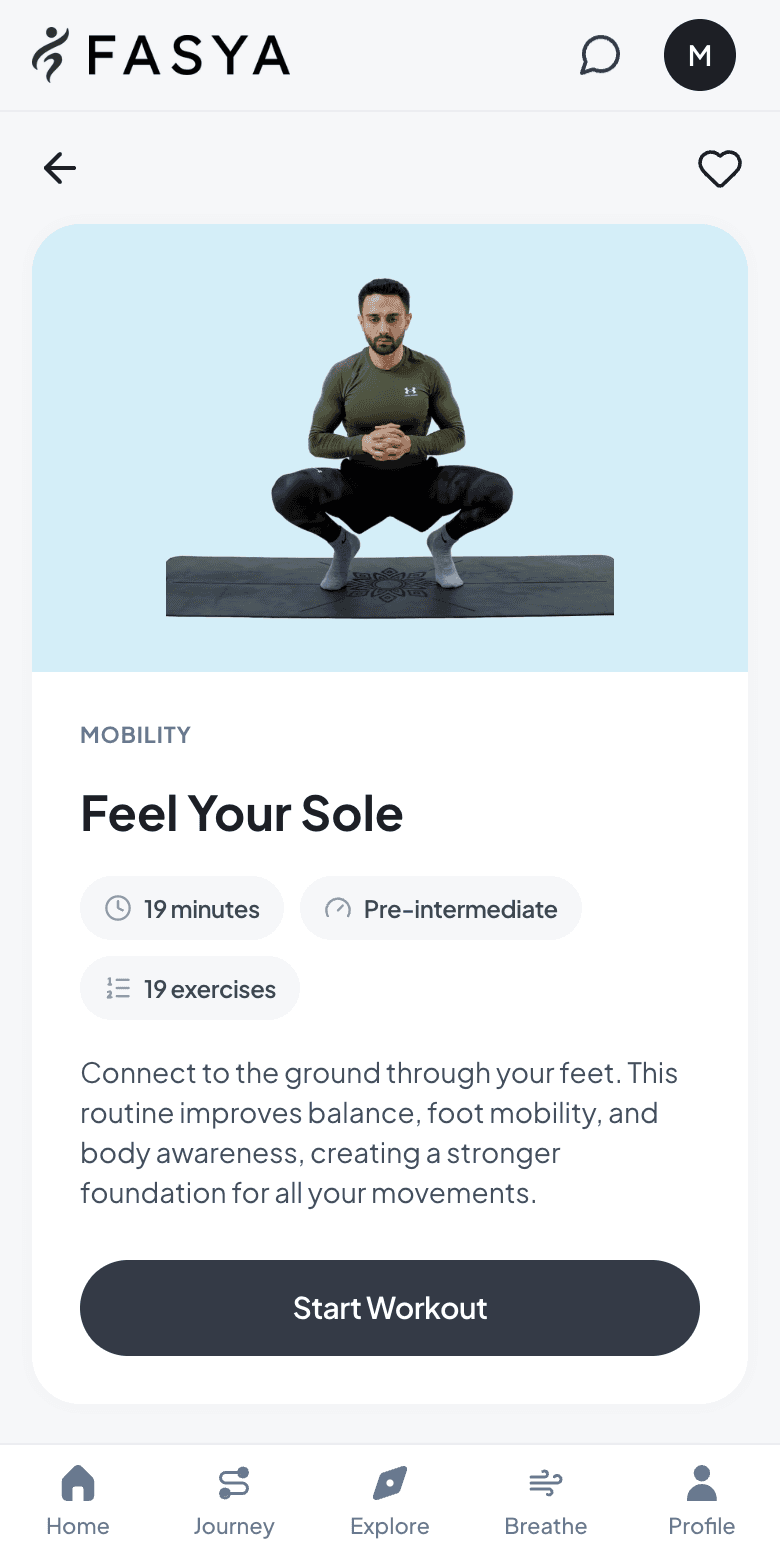
So what should you do? In short: don't cut the load, adjust it and spread it across the day. Remembering to get up between long stretches of sitting and give your foot small doses is the hardest part. To work your foot and calf gradually, the app has the Feel Your Sole workout; keep the dose to what the pain allows.
What helps heel pain?
Research doesn't agree on everything here. So instead of a firm prescription, here's the most sensible order:
- Shrink the dose, don't zero it. For a while, cut back on whatever clearly makes the pain worse (long standing, hard floors, walks longer than you're used to). You don't have to stop completely.
- Strengthen your calf and sole. Put a rolled-up towel under your toes, raise your heel slowly, lower it slowly. In one randomised trial, this kind of high-load strength work gave better results for pain and function after three months than stretching alone. It's a single study, so read the result with some caution.
- Keep stretching, but don't expect everything from it. It's in the guidelines and it brings quick relief. On its own it doesn't seem to carry the change.
- Insoles are worth a try. Reviews show a small benefit in the short and medium term, with no difference left in the long term.
Keep your expectations realistic too. If it still aches in week two, that doesn't mean you're doing something wrong.
Fasya is a 5-minute-a-day mobility app, and its short movement breaks are built on the same idea: spread the load across the day instead of piling it into one session.
Frequently asked questions
- Is it normal for my heel to hurt in the morning?
- Heel pain on the first steps in the morning is common and usually doesn't point to a tear. The tissue under your foot has no load overnight and takes your full weight on the first step; once it adjusts after a few steps, the pain generally eases.
- Is a heel spur causing my pain?
- A heel spur seen on an X-ray doesn't decide on its own how the pain will go. A study that followed 174 people for 5 to 15 years found the spur did not predict recovery.
- Do insoles help heel pain?
- Insoles can give a small benefit in the short and medium term, but reviews see no difference in the long run. They're worth trying; just don't expect them to be enough on their own.
- How many months does heel pain take to go away?
- It's hard to give an exact time; this kind of pain moves on a scale of months, not weeks. If it lasts longer than three months, wakes you at night or comes with numbness, it's a good idea to see a physiotherapist or doctor.
Sources
Sources are taken from the expert-reviewed content cards in Fasya's knowledge base.
- Plantar Fasciitis: A Degenerative Process (Fasciosis) Without Inflammation — Lemont H, Ammirati KM, Usen N, 2003
- Is 'plantar heel pain' a more appropriate term than 'plantar fasciitis'? Time to move on — Riel H, Cotchett M, Delahunt E, Rathleff MS, Vicenzino B, Weir A, et al., 2017
- Long-Term Prognosis of Plantar Fasciitis: A 5- to 15-Year Follow-up Study of 174 Patients With Ultrasound Examination — Hansen L, Krogh TP, Ellingsen T, Bolvig L, Fredberg U, 2018
- High-load strength training improves outcome in patients with plantar fasciitis: A randomized controlled trial with 12-month follow-up — Rathleff MS, Mølgaard CM, Fredberg U, Kaalund S, Andersen KB, Jensen TT, et al., 2015
- Heel Pain-Plantar Fasciitis: Revision 2014. Clinical Practice Guidelines Linked to the ICF — Martin RL, Davenport TE, Reischl SF, McPoil TG, Matheson JW, Wukich DK, et al., 2014
- Foot orthoses for plantar heel pain: a systematic review and meta-analysis — Whittaker GA, Munteanu SE, Menz HB, Tan JM, Rabusin CL, Landorf KB, 2018
This article is for information only; it does not diagnose and is no substitute for an examination. If your symptoms persist, see a clinician.