
Which desk stretches actually work at the office?
Desk stretches you can do without leaving your chair: a routine of a few minutes for neck, shoulders, shoulder blades and torso. Why frequency beats duration.
It's quarter past three. You've just come out of your third meeting, you turn back to the screen, and that familiar ache at the back of your neck is there again.
The stretches that work at the office are actually simple: slowly turning and tilting your neck, reaching your arms overhead, working your shoulder blades and rotating your torso. The real difference lies less in the movement itself than in how often you do it. Two or three minutes a few times a day does more than one long session a week.
Why are short breaks better than one long session?
Because the relaxing effect of stretching is short-lived. In one study, the drop in stiffness of the muscle-tendon unit after stretching was gone within ten minutes. The rise in pain threshold that movement brings also fades within a few hours. Feeling loose is something that has to be topped up during the day.
The tissue itself runs on a similar clock. The building response that movement triggers (collagen synthesis) peaks about 24 hours after a session and returns to baseline in two to three days. Frequent movement keeps that window open.
An honest note: when the total amount is matched, splitting the same work into small pieces does not give more gains on its own. The advantage of small doses is that you can keep them up. Short lists get repeated more.
How much stretching per day is enough?
We don't know for sure. In 2020 the World Health Organization dropped the rule that activity should last "at least ten minutes at a time"; now every bit of movement counts, and breaking up long periods of sitting is part of the recommendation. In a study of people who don't exercise regularly, even three to four minutes a day in total of short, brisk everyday movement was linked to a lower risk of death.
But those numbers are about general health. For stiffness and flexibility there is no established minimum dose; a review pooling stretching studies didn't even find a clear relationship between total time and range of motion gained. Enough for you is the amount you can keep repeating.
The rule is that plain. The hard part is remembering to get up at four o'clock when you're buried in an email. Fasya's Daily Movement Snack is there for exactly that moment. We covered the heaviness that comes from sitting for a long time in a separate article.
Which stretches can you do at your desk?
For neck pain, the first thing guidelines put on the list is movement and exercise for the neck and shoulder blade area. In reviews, what makes the difference is not stretching alone but also light strength and endurance work. That's why the list has both:
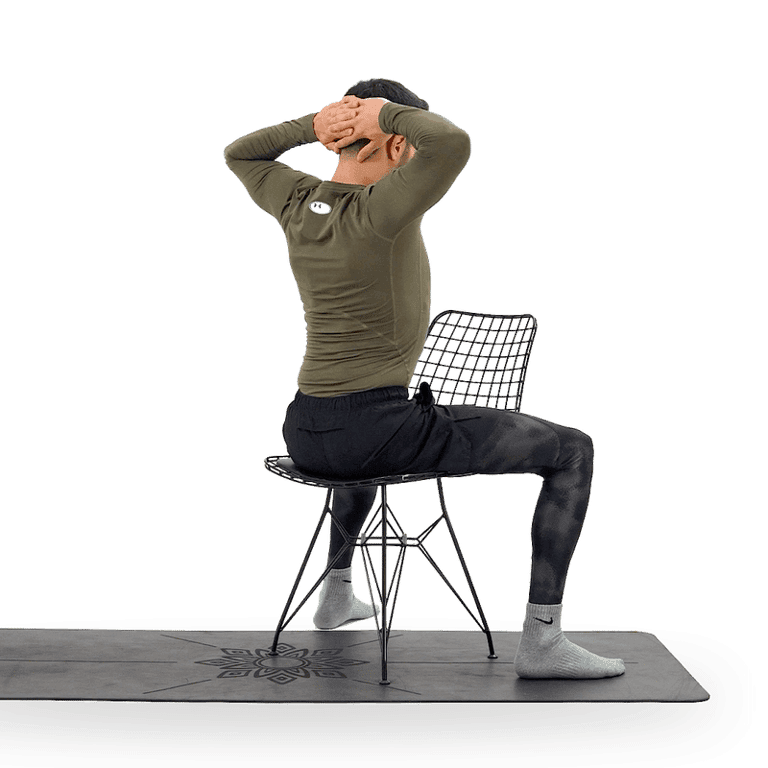
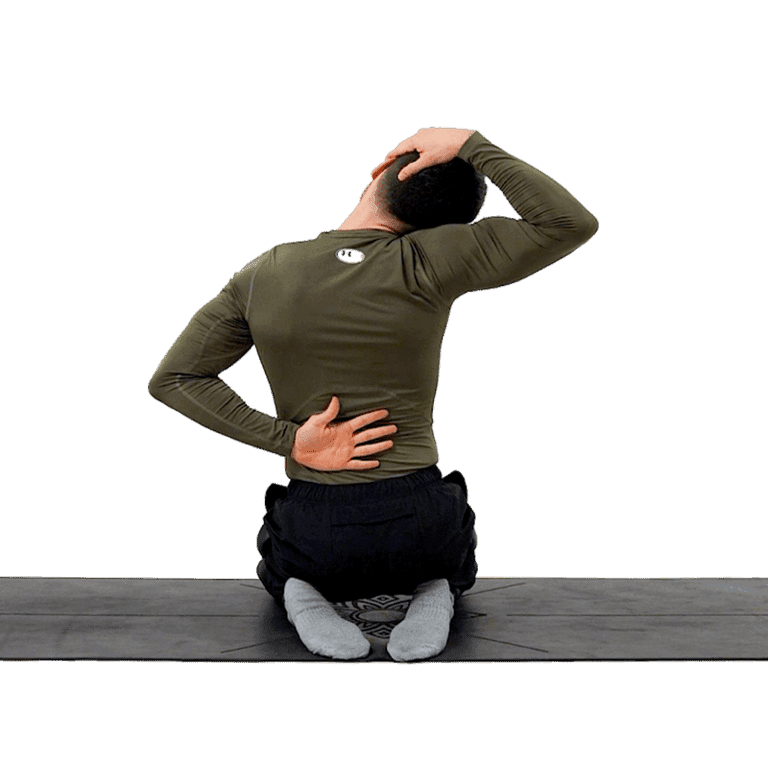
- Neck turns and side tilts. Slowly turn your head right, then left; then tilt your ear towards your shoulder. Five times in each direction, as far as pain allows.
- Shoulder rolls. Lift your shoulders towards your ears, then let them go back and down in a circle. Eight to ten rounds.
- Arms overhead. Interlace your fingers, turn your palms to the ceiling and reach a little further as you breathe in. Three or four breaths.
- Shoulder blade squeeze. Draw your shoulder blades together, hold for three seconds, release. Ten reps. Raising and lowering your arm out to the side with a full water bottle in your hand counts as light resistance.
- Seated torso rotation. Put one hand on the opposite knee, turn your torso that way and let your gaze follow. Three breaths each side.
The whole thing takes three or four minutes. A gentle pulling feeling is fine; sharp or steadily increasing pain is not. Fasya is a mobility app that takes a few minutes a day, and its movement breaks are built on the same logic: short, no equipment, without leaving your desk.
Frequently asked questions
- Do desk stretches help with neck pain?
- Movement is the first thing guidelines recommend for neck pain. The difference is clearer when, instead of just stretching, you also work the neck and shoulder blade area against light resistance.
- How many times a day should I stretch at work?
- There is no exact number that applies to everyone. A practical rule: get up or take a break of a few minutes every hour, and change position now and then while you sit.
- Should I keep going if my neck hurts while stretching?
- A gentle pulling feeling is normal; sharp or steadily increasing pain is not. If the pain is sudden and very severe, or comes with symptoms such as dizziness or double vision, stop stretching and go to the emergency department.
Sources
Sources are taken from the expert-reviewed content cards in Fasya's knowledge base.
- Decrements in stiffness are restored within 10 min — Mizuno T, Matsumoto M, Umemura Y, 2013
- Coordinated collagen and muscle protein synthesis in human patella tendon and quadriceps muscle after exercise — Miller BF, Olesen JL, Hansen M, et al., 2005
- Effects of resistance training frequency on measures of muscle hypertrophy: a systematic review and meta-analysis — Schoenfeld BJ, Ogborn D, Krieger JW, 2016
- Effect of number of home exercises on compliance and performance in adults over 65 years of age — Henry KD, Rosemond C, Eckert LB, 1999
- World Health Organization 2020 guidelines on physical activity and sedentary behaviour — Bull FC, Al-Ansari SS, Biddle S, et al., 2020
- Association of wearable device-measured vigorous intermittent lifestyle physical activity with mortality — Stamatakis E, Ahmadi MN, Gill JMR, et al., 2022
- Chronic effects of stretching on range of motion with consideration of potential moderating variables: a systematic review with meta-analysis — Konrad A, Alizadeh S, Daneshjoo A, et al., 2024
- Neck Pain: Revision 2017. Clinical Practice Guidelines Linked to the ICF — Blanpied PR, Gross AR, Elliott JM, et al., 2017
- Exercises for mechanical neck disorders (Cochrane Review) — Gross A, Kay TM, Paquin JP, et al., 2015
- Active neck muscle training in the treatment of chronic neck pain in women: a randomized controlled trial — Ylinen J, Takala EP, Nykänen M, et al., 2003
- International Framework for Examination of the Cervical Region for Potential of Vascular Pathologies of the Neck Prior to Musculoskeletal Intervention — Rushton A, Carlesso LC, Flynn T, et al., 2023
- The Canadian C-spine rule for radiography in alert and stable trauma patients — Stiell IG, Wells GA, Vandemheen KL, et al., 2001
- International Framework for Red Flags for Potential Serious Spinal Pathologies — Finucane LM, Downie A, Mercer C, et al., 2020
This article is for information only; it does not diagnose and is no substitute for an examination. If your symptoms persist, see a clinician.
Related articles
Why does my neck hurt when I sit at the computer?
Is it your posture, a forward head or the 'flat neck' on your X-ray? Research blames all three far less than you would think. Why the neck gets tired, how it works with the upper back and shoulders, and what you can do today.
Stiff neck: why it happens and how long it lasts
You wake up and your head won't turn one way. A stiff neck is usually not a tear, it's protection. Why it happens, how long it lasts and what you can do in the first few days.